


Why Is My Recliner Sofa Uncomfortable? Common Causes and Fixes

A recliner sofashould be the most comfortable seat in your home. So when yours leaves you with back pain, a stiff neck, or restless legs after thirty minutes, something is clearly wrong - and it's rarely just "you got used to it." Most recliner comfort problems have specific, identifiable causes with equally specific fixes.
This guide covers every major reason a recliner sofa becomes uncomfortable - whether it was never right for your body or has simply worn out - and gives you both a quick fix and a permanent solution for each one.
Why Is My Recliner Sofa Uncomfortable? - At a Glance
Before diving into detail, use this table to quickly match your symptom to its most likely cause and the right type of fix.
| Cause | Symptom | Solution | Type |
| Wrong seat height | Feet dangle or knees too high | Adjust feet pads or add seat riser | Quick Fix |
| Seat too deep / too shallow | Thighs unsupported or perched | Add lumbar roll or swap sofa | Quick / Permanent |
| Sagging cushions | Foam compressed or webbing broken | Foam topper or full replacement | Quick / Permanent |
| Poor lumbar support | Lower back pain after 20+ min | Add lumbar pillow or upgrade | Quick Fix |
| Wrong recline angle | Neck strain or leg discomfort | Adjust backrest; use headrest pillow | Quick Fix |
| Footrest height mismatch | Calves unsupported, leg fatigue | Add footrest pad or adjust mechanism | Quick Fix |
| Headrest position | Neck forward or unsupported | Adjust headrest angle / add pillow | Quick Fix |
| Wrong sofa size for body | Too small or too big overall | Size-match on next purchase | Permanent |
Cause 1: Wrong Seat Height
How seat height makes a recliner sofa uncomfortable
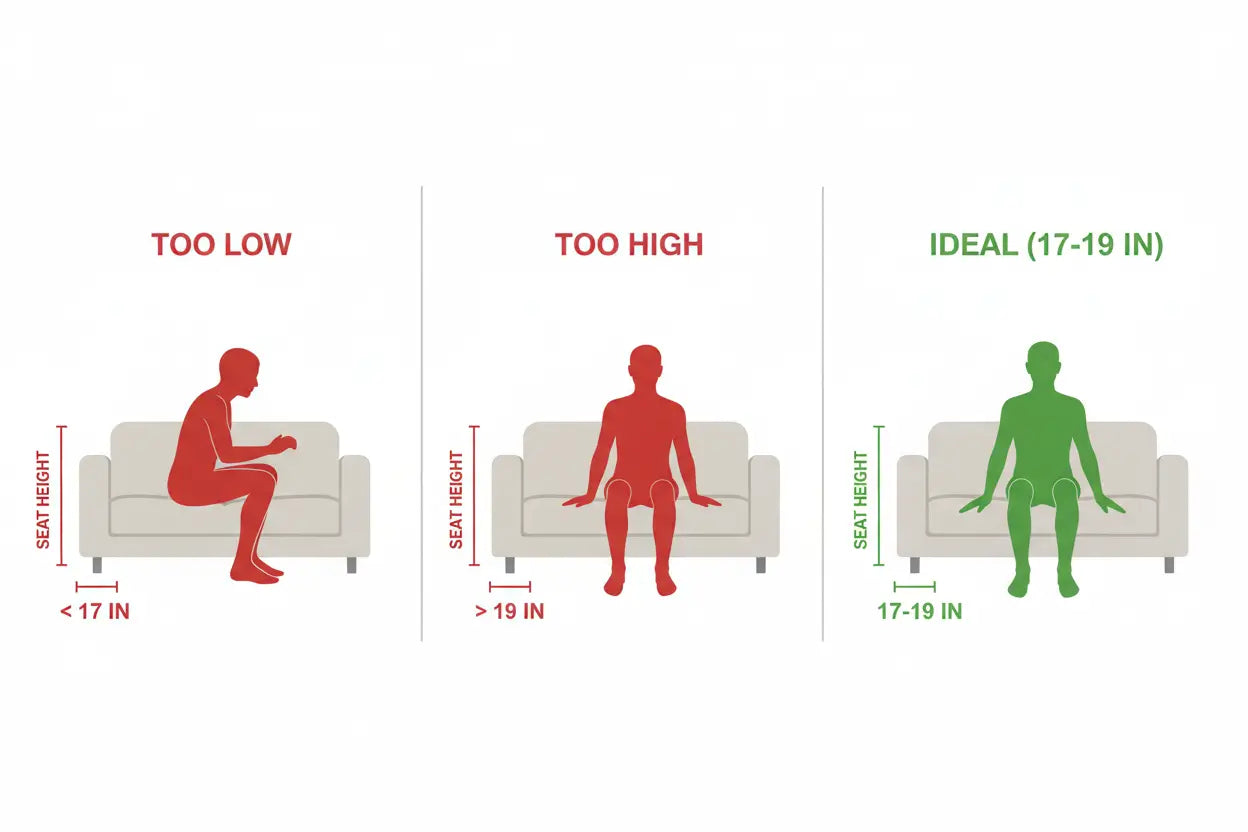
Seat height is the measurement from the floor to the top of the seat cushion, typically 17 to 20 inches on a standard recliner. When this doesn't match your leg length, everything else suffers. If the seat is too high, your feet dangle, creating pressure under your thighs and cutting off circulation. If the seat is too low, your knees rise above your hips - a position that strains both the lower back and the hip flexors.
Quick fix
For a seat that is too low: add a firm seat riser or a high-density foam wedge cushion (2-3 inches) to bring the seat height up. For a seat that is too high: remove casters if fitted, or use a rug to effectively lower your sitting position relative to the floor.
Permanent fix
Replace the leg feet with shorter or taller alternatives - most recliner sofa legs are threaded and interchangeable. For persistent height issues, the seat height should be your first measurement when buying a replacement.
Cause 2: Seat Depth Is Wrong for Your Body
Why seat depth causes recliner sofa discomfort
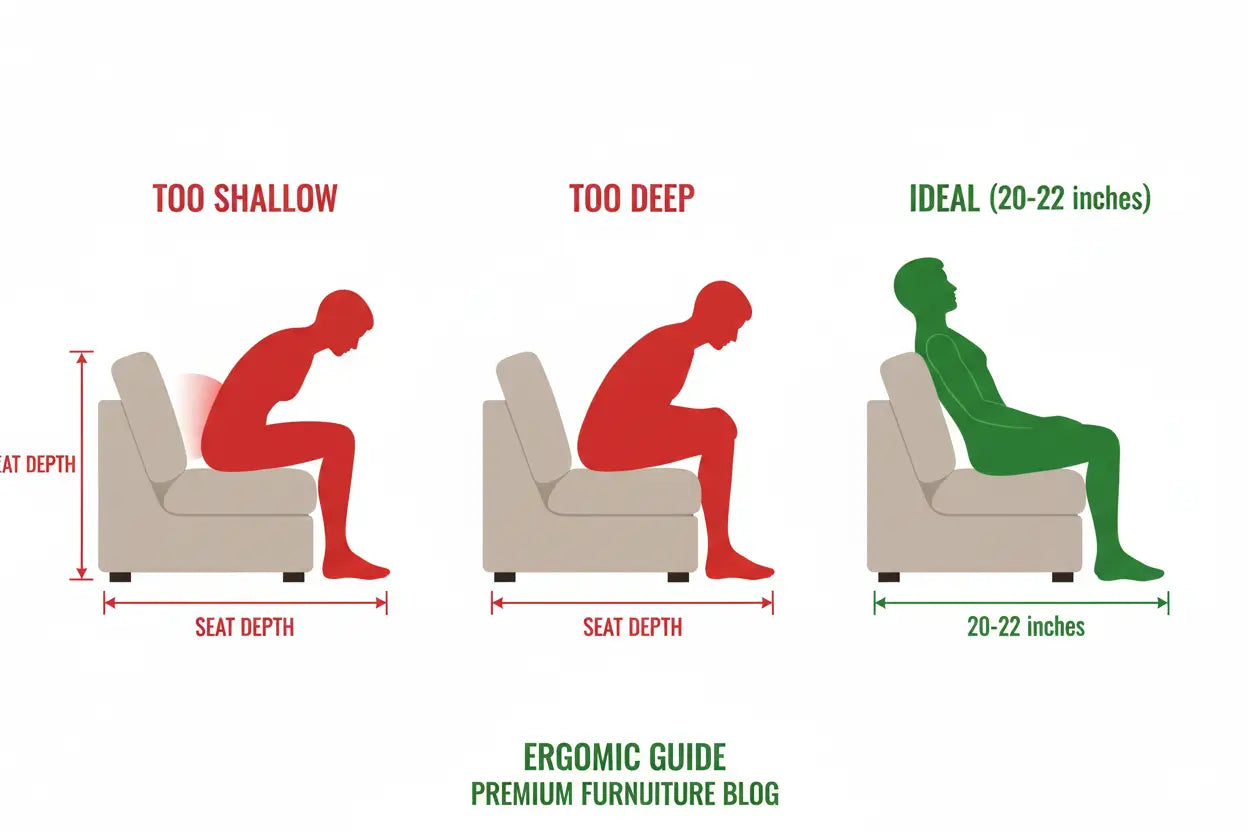
Seat depth - the measurement from the front edge of the cushion to the back cushion - is one of the most overlooked comfort factors. The correct seat depth should match your thigh length. When seated, there should be 2-3 inches of clearance between the back of your knee and the front of the seat cushion.
Seat too deep: You either sit forward with your back unsupported, or lean back with your legs elevated awkwardly - both create lower back and sciatic strain after 20-30 minutes.
Seat too shallow: Your thighs are not fully supported, causing a perched feeling and pressure concentrated at the back of the knees.
Quick fix
For a seat that is too deep: add a firm lumbar cushion behind your lower back to effectively shorten the functional seat depth. For a seat too shallow: a memory foam seat pad adds surface area at the front.
Permanent fix
When buying, always measure your thigh length seated (back of knee to buttocks) and add 2-3 inches for your ideal seat depth. Petite adults typically need 18-20 inches; average height adults 20-22 inches; tall adults 22-26 inches.
Tip The Fist TestSit in your recliner in the upright position. You should be able to slide a loosely closed fist between the back of your knee and the front of the seat cushion. Less than a fist means the seat is too shallow; more than two fists means it is too deep.
Cause 3: Sagging or Compressed Cushions
Why sagging cushions make a recliner sofa uncomfortable
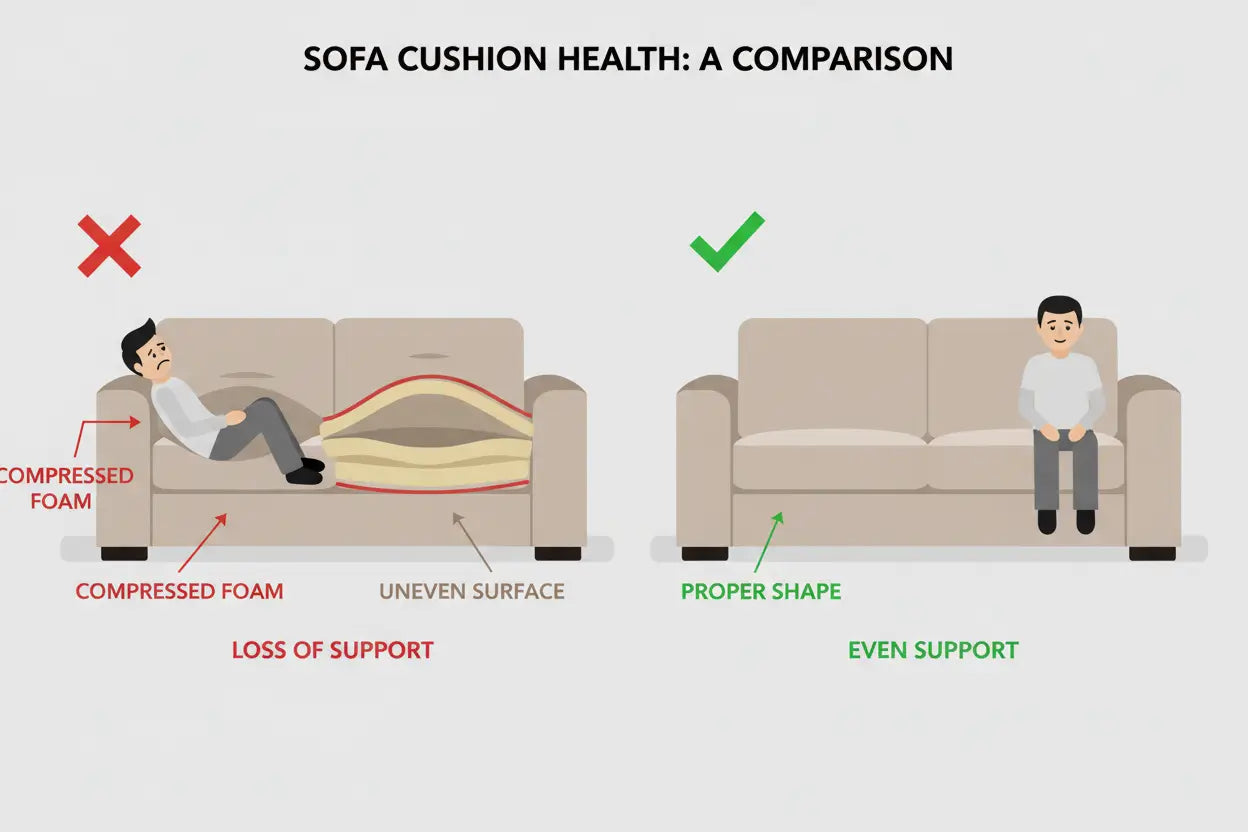
Recliner sofa cushions lose their supportive density over time. Standard polyfoam (below 1.8 lb/cu ft density) typically compresses noticeably after 3-5 years of regular use. The result is a hammock-like sag in the seat center - your hips drop lower than your knees, the pelvis tilts backward, and lower back pain follows. Separately, the seat webbing (elastic straps or sinuous springs beneath the cushion) can weaken or break, causing uneven support.
How to diagnose cushion sag
- Remove the seat cushion and press firmly on the base. If your hand sinks more than an inch with moderate pressure, the webbing has weakened.
- Place the cushion on a flat floor and press the center. If it compresses more than 40% of its original depth and doesn't spring back within 3 seconds, the foam has lost density.
Quick fix
Place a high-density foam topper (2-inch, 2.0 lb/cu ft) under the seat cushion inside its cover. This restores height and firmness without permanent modification and costs $20-$50.
Permanent fix
Replace the foam insert entirely. Most recliner seat cushions have a zippered cover - remove the old foam, measure it, and order a replacement in 1.8-2.0 lb/cu ft high-density foam, cut to size. For webbing failure, a sinuous spring repair kit ($20-$40) or elastic webbing replacement kit restores the seat base.
Cause 4: Insufficient Lumbar Support
Why poor lumbar support causes recliner back pain
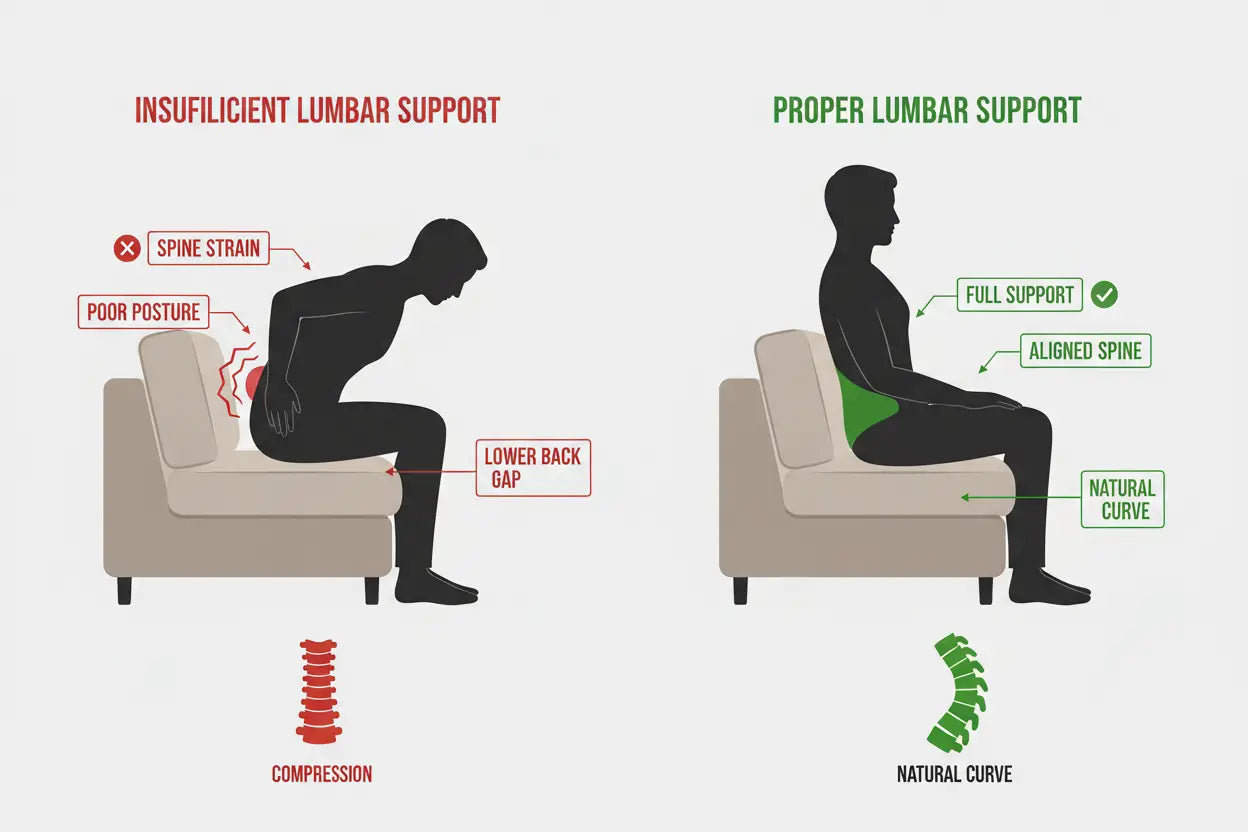
The lumbar region - the inward curve of your lower spine between your ribcage and pelvis - needs continuous support to stay in its natural position. Most budget recliner sofas have a flat or minimally contoured back cushion that fails to maintain this curve, especially in the reclined position. When the lumbar curve is unsupported for 20 minutes or more, the surrounding muscles fatigue trying to compensate, which is what most people experience as lower back pain from a recliner sofa.
Quick fix
Add a dedicated lumbar support cushion ($20-$60) positioned at the small of your back. Roll-style lumbar pillows work well for upright sitting; D-shaped memory foam supports work better for the reclined position. Reposition it whenever you change recline angle.
Permanent fix
When buying a new recliner sofa, look specifically for models with a built-in lumbar zone - a firmer section in the lower third of the back cushion. This should be listed in the product specifications. Avoid recliners described as having a uniform "plush" back cushion, as these rarely provide adequate lumbar differentiation.
Warning Recliner Back Pain Is Not Normal
Many people assume lower back pain from prolonged sitting is inevitable. In a correctly fitted recliner sofa, back pain should not occur during the first 2 hours of use. If yours causes pain within 30 minutes, it is a fit problem - not a personal one.
Cause 5: Incorrect Recline Angle
What is the correct recline angle for a recliner sofa?
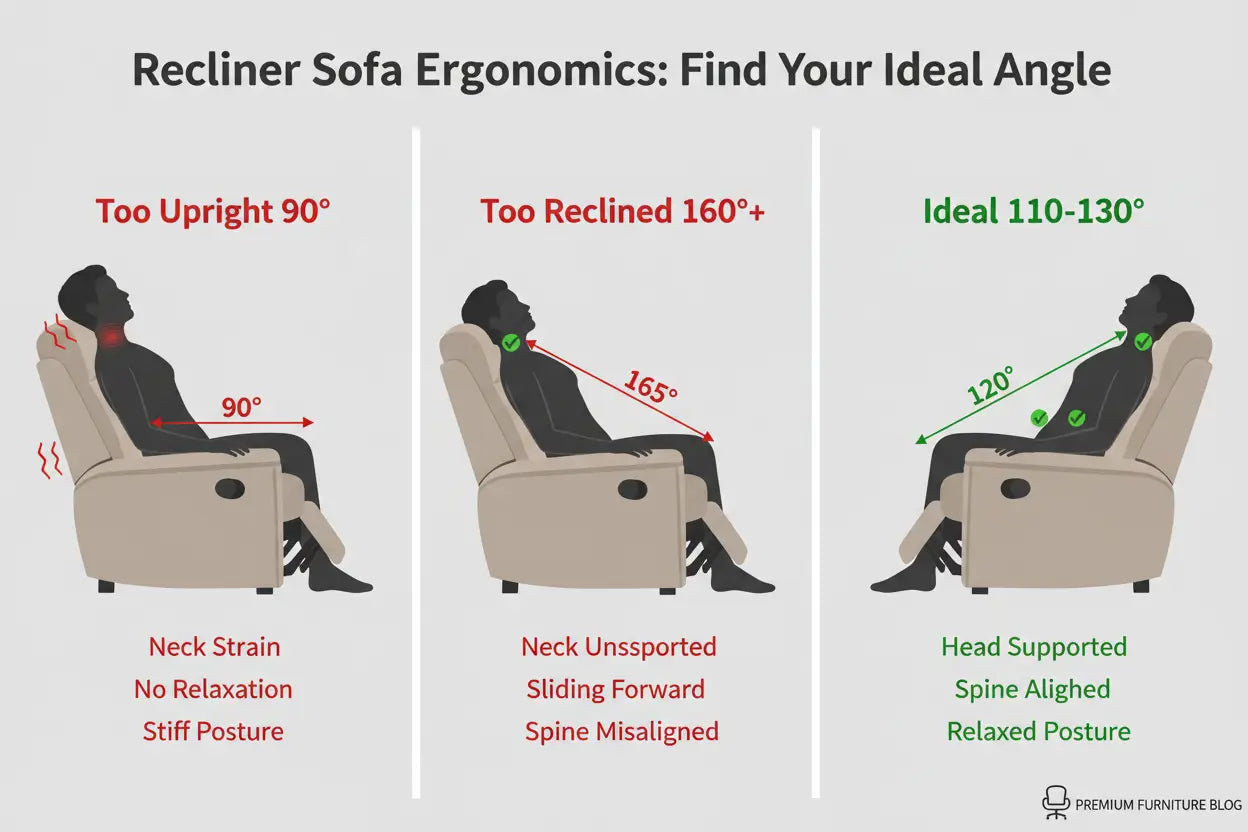
The ideal recline angle depends on your intended use. For upright activities like reading or watching TV, a backrest angle of 100-115 degrees (measured from the seat) maintains spinal alignment. For relaxed lounging, 120-135 degrees distributes body weight across a larger surface area and reduces spinal compression. Full recline (150+ degrees) is best for short napping only - holding this position for extended periods without adequate head and neck support causes cervical strain.
How a wrong recline angle creates discomfort
Too upright (90 degrees): Concentrates full body weight on the seat base; hamstrings tighten; lower back compresses.
Too reclined (150+ degrees for reading): Head falls forward straining the neck, arms must be raised to hold reading material, hip flexors become overstretched.
Quick fix
Experiment with your recliner's angle settings systematically. Most manual recliners have multiple lock positions - try each one for 10 minutes and note which reduces your specific discomfort. Add a wedge neck pillow for head support in the more reclined positions.
Cause 6: Footrest Height Mismatch
Why footrest position affects recliner sofa comfort
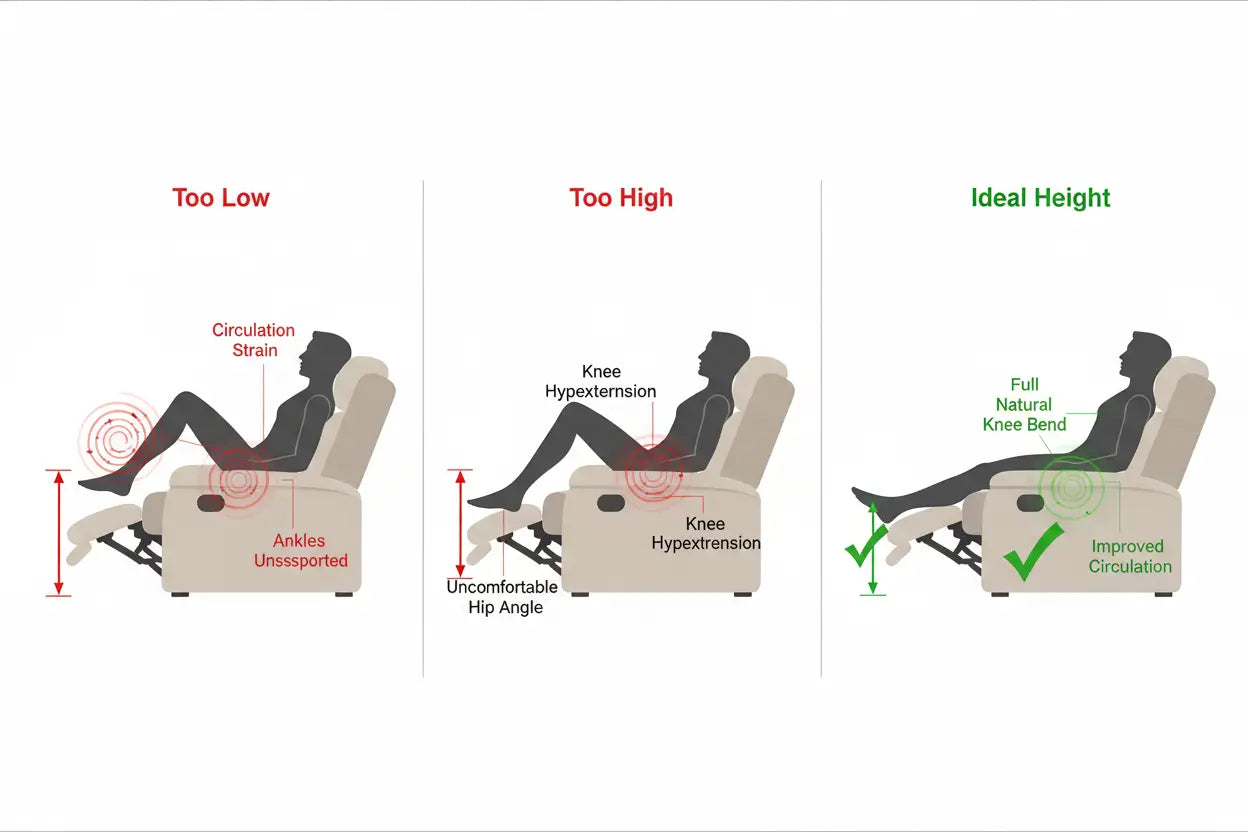
When the recliner footrest is extended, it should support your calves without placing your heels at the edge (too short) or bending your knees over the footrest edge (too long). An incorrect footrest height creates a pressure point at the back of the calf or forces the knees into a bent position - both of which restrict blood flow and cause discomfort in the lower legs within 20-30 minutes.
Quick fix
Add a folded blanket or small pillow on top of the footrest to raise the support surface if the footrest is too short. If the footrest is too long and forces your legs into an uncomfortable angle, try placing your heels on a small footstool placed just beyond the recliner footrest extension.
Permanent fix
When buying, sit in the recliner in the fully reclined position and check that the footrest supports your calves fully - no edge pressure behind the knee, no heels hanging off the end. Taller buyers should look for models with extended footrest options.
Cause 7: Headrest Position Causes Neck Strain
How headrest design causes recliner sofa neck pain
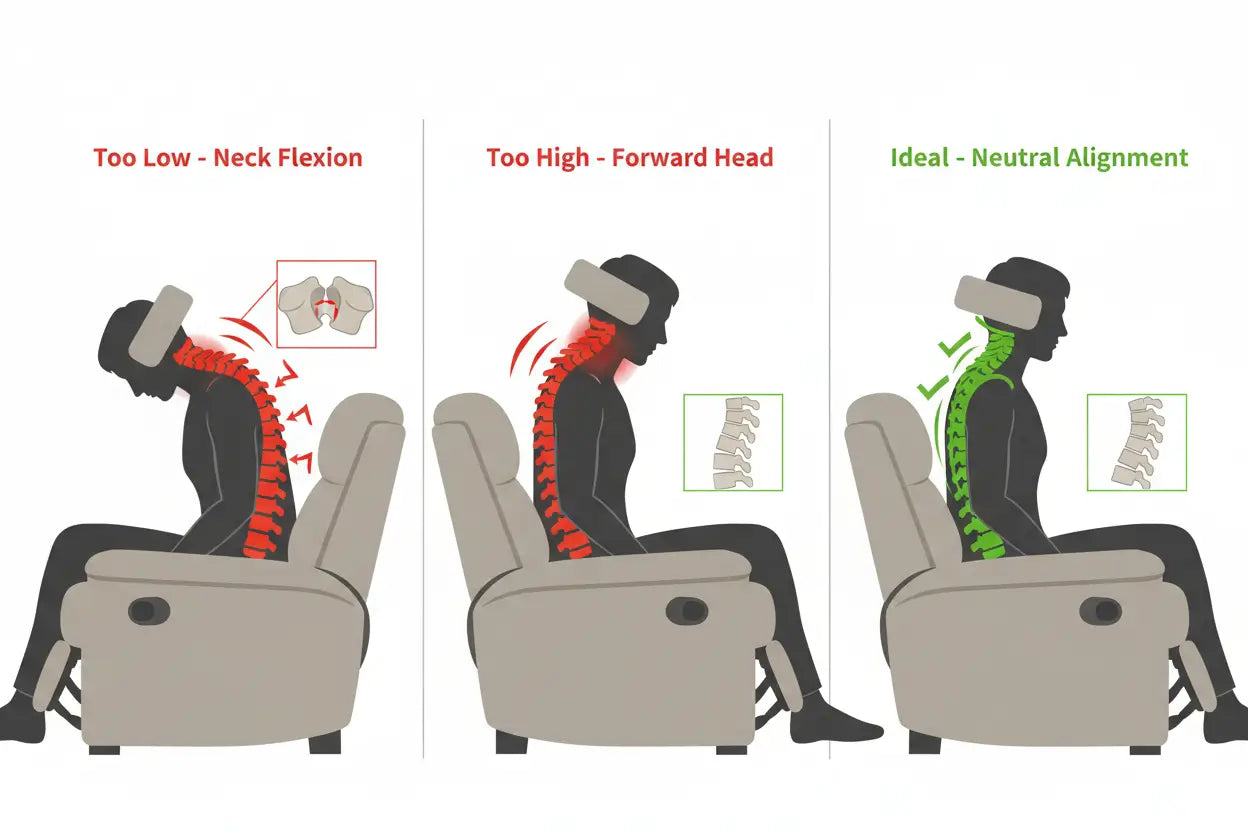
A fixed headrest that pushes the head forward (chin to chest) strains the cervical spine within minutes. This is extremely common on older recliner sofas where the headrest is built into the back cushion at a fixed forward angle. Equally, a headrest that is too low (supporting the upper back rather than the head) provides no benefit and forces the user to hold their own head up against gravity in the reclined position.
Quick fix
Add an adjustable headrest pillow with a neck roll ($20-$50) that can be repositioned as you change recline angle. Place it so it supports the natural inward curve of the cervical spine - not pushing the head forward.
Permanent fix
Look for recliner sofas with an adjustable headrest as a feature - either manually pivoting or on a sliding track. This is a feature increasingly available across mid-range and premium recliner sofas and is worth specifying if neck comfort has been an issue.
How Body Type and Height Affect Recliner Sofa Comfort
A recliner sofa that fits one body perfectly will be wrong for another. These are the key dimension matches by body type:
| Body Type | Ideal Seat Depth | Ideal Seat Height | Other Needs |
| Under 5'4" / Petite | Seat depth 18-20" | Seat height 17-18" | Lighter spring tension |
| 5'4" - 5'10" Average | Seat depth 20-22" | Seat height 18-20" | Medium foam density |
| 5'11"+ / Tall | Seat depth 22-26" | Seat height 20-22" | Firmer lumbar zone |
| Heavier build (200lb+) | High-density foam | Reinforced frame | Firm seat preferred |
The single most important matching principle: your thigh length seated determines your ideal seat depth, and your lower leg length determines your ideal seat height. Measure both before buying any recliner sofa.
Was Your Recliner Never Right - or Has It Worn Out?
This distinction matters because the fix is completely different.
Signs your recliner was never the right fit
- Discomfort began within the first few weeks of purchase.
- The discomfort is consistent regardless of position or sitting duration.
- Your discomfort pattern matches the size/fit issues above (seat depth, height, footrest).
- Other people of similar height complain about the same sofa.
Signs your recliner has worn out over time
- It was comfortable for years before the discomfort started.
- You can feel a dip or unevenness in the seat cushion.
- The recline mechanism feels looser or stops at different angles than it used to.
- The back cushion has visibly flattened or shifted.
Key point: A worn-out recliner can often be restored with cushion replacement and mechanical adjustment. A recliner that was never the right fit requires a different purchase - restoring it won't solve a fundamental size mismatch.
What to Look for When Buying a Recliner Sofa to Avoid Comfort Issues
The best time to solve recliner sofa discomfort is before you buy. Use this checklist:
| Feature | What to Look For |
| Seat depth | 20-22" for average height; 18-20" for petite; 22-26" for tall |
| Seat height | 17-20" from floor - feet should rest flat |
| Foam density | Minimum 1.8 lb/cu ft; 2.0+ lb for heavier users |
| Lumbar zone | Look for built-in lumbar curve, not flat back cushion |
| Headrest | Adjustable or removable preferred for height variation |
| Recline range | 100-120 degrees for upright; 130-150 degrees for full lounge |
| Frame material | Hardwood or steel preferred over engineered wood |
| Test duration | Sit for at least 5 minutes in showroom before buying |
Key Rule The 5-Minute Showroom Test
Never buy a recliner sofa based on how it feels in the first 30 seconds. Sit for at least 5 full minutes in your normal sitting posture - upright, reading position, and fully reclined. Discomfort that appears at 3-4 minutes in a showroom will be much worse after an hour at home.
Conclusion
Recliner sofa discomfort is almost never random - it traces back to one or more specific, fixable causes: a size mismatch, worn-out cushions, inadequate lumbar support, or a poorly positioned headrest. Working through the causes systematically, starting with the quick fixes, will resolve most discomfort without requiring a replacement sofa.
If you are ready to invest in a recliner sofa that gets the fundamentals right from the start, Magic Homedesigns its recliner sofa collection with ergonomic seat depth options, built-in lumbar zones, and adjustable headrests that address the most common comfort failures across different body types. Whether you need a compact recliner for a smaller frame or a wide, deep-seat model for a taller build, Magic Home's range is engineered for genuine long-term comfort rather than just first-impression softness.
Frequently Asked Questions
Lower back pain from a recliner sofa is almost always caused by insufficient lumbar support, a seat that is too deep for your body, or sitting at a recline angle that lets the pelvis tilt backward. The most immediate fix is to add a firm lumbar support pillow positioned at the small of your back. If the pain persists after adding lumbar support, the seat depth is likely the underlying issue - measure your thigh length seated and compare it to the sofa's seat depth specification.
If you learn more, please click here: Best Recliner Sofa for Back Pain
The best seat depth for a recliner sofa is one that matches your thigh length. Seated, there should be 2-3 inches of clearance between the back of your knee and the front of the seat cushion. For most adults under 5'4", a seat depth of 18-20 inches is ideal. For average-height adults (5'4" to 5'10"), 20-22 inches works well. Taller adults over 5'11" typically need 22-26 inches. Always measure your own thigh length seated before buying.
If you want to learn more about sofa size, please check Sofa Size Guide: Dimensions, Measurements & Calculator
Standard polyfoam recliner cushions typically need replacement every 5-8 years with regular daily use. High-density foam (2.0 lb/cu ft or above) can last 10-15 years. The most reliable test is the compression test: press the center of the cushion firmly and release - if it does not return to its original height within 3 seconds, the foam has lost its supportive density and needs replacing. Cushion replacement is almost always cheaper than a new sofa and immediately restores comfort.
If you learn more, please click here: What Factors Can Extend Recliner Sofa Lifespan?