


How to Make a Small Living Room Feel Bigger with the Right Sofa

Small living rooms are one of the most common design challenges homeowners face, and the sofa is almost always the biggest variable. It is the largest piece of furniture in the room, the first thing you see when you walk in, and the item most likely to make a space feel cramped or comfortable. The good news is that choosing the right sofa - the right size, shape, color, and position - can make even a 12 m² living room feel open, airy, and well-designed.
This guide covers everything you need to know to choose and position a sofa that works with a small living room rather than against it, including the mistakes most people make and the space-saving strategies that actually work.
Sofa Size and Scale: The Foundation of a Small Space
The number one mistake people make in small living rooms is choosing a sofa that is too large. A sofa that dominates the room blocks light, impedes traffic flow, and creates a psychologically heavy atmosphere. Scale is everything.
The Two-Thirds Rule
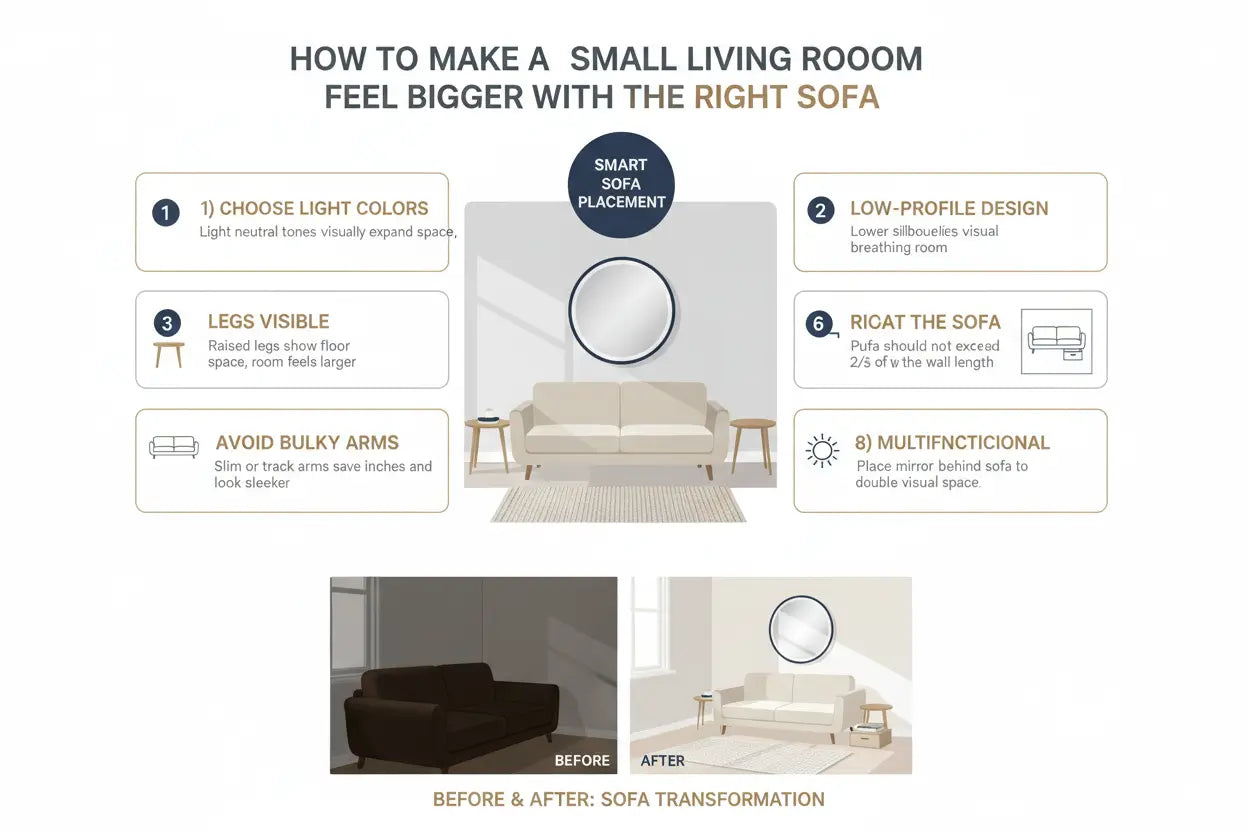
Your sofa should be no wider than two-thirds of the wall behind it or the wall it faces. For a 3.5 m wall, that means a sofa no longer than approximately 230 cm. This rule preserves visual breathing room on each side of the sofa, which is one of the most effective ways to make the room feel larger.
Seat Depth and Arm Height
Seat depth: Choose a sofa with a seat depth of 55-65 cm for small rooms. Deep-seat sofas (70 cm+) are comfortable but eat into floor space and can feel overwhelming. Shallower seats also make it easier to get up, which is relevant in tight spaces.
Arm height: Low or track arms (arms that sit at or slightly above seat height) keep the visual silhouette of the sofa low and horizontal. High, pillowy rolled arms add perceived visual bulk and make a sofa look heavier than it is. In small rooms, low arms are almost always the right choice.
Leg Height: The Underrated Space Expander
Sofa legs are one of the most overlooked factors in small-space design. Legs that are 15 cm or taller lift the sofa off the floor, creating a visible gap underneath. This gap allows the eye to travel across the full width of the floor, making the room feel significantly larger. By contrast, sofas that sit directly on the floor or have very short legs create a solid mass that makes the room feel heavier and more confined.
Pro Tip
Exposed wooden or metal legs on a sofa are a simple upgrade that can transform how spacious a room feels. If you already own a sofa with very short legs, consider furniture risers as a low-cost fix.
Best Sofa Shapes for Small Living Rooms
Not every sofa shape works in a small room. Here is a practical guide to the most common options, from the most space-efficient to the most feature-rich compact alternatives.
| Sofa Type | Width Range | Best For | Consideration |
| Loveseat (2-seat) | Under 140 cm | Best for very small rooms or studio apartments | Limited seating capacity |
| Apartment / Compact Sofa | 140-180 cm | Balances comfort and footprint for rooms under 15 m² | Works in most small rooms |
| Slim 3-Seater | 180-210 cm | Seat 3 without overwhelming the room | Needs 15-20 m² minimum |
| Small L-Shape / Sectional | 200-240 cm per side | Doubles as room divider, maximizes corner space | Measure doorway clearance |
| Modular Sofa | Configurable | Adaptable to any layout, buy only what fits | Higher per-piece cost |
Loveseat
A loveseat (typically 120-140 cm wide) is the most space-efficient sofa option. It works well in studio apartments, narrow living rooms, or rooms where the sofa must share space with a large dining table. The trade-off is limited seating - ideal for one or two people, but not for households that frequently entertain.
For specific product recommendations, see our Best Reclining Loveseat for Small Spaces guide。
Apartment or Compact Sofa
The apartment sofa is a 2.5 or small 3-seat sofa designed specifically for urban living. At 140-180 cm, it fits comfortably in rooms as small as 12-15 m² while still seating three adults. Many furniture brands design their apartment sofa lines with low arms, high legs, and slimmer profiles specifically for this market.
Small L-Shape Sectional Sofa
A small sectional sofa is often dismissed as too large for small rooms, but when sized correctly it can actually be more space-efficient than a sofa-plus-armchair combination. An L-shape that measures 200 cm x 150 cm can replace a three-seat sofa and an additional chair while consolidating all the seating into one corner. This leaves the rest of the floor open.
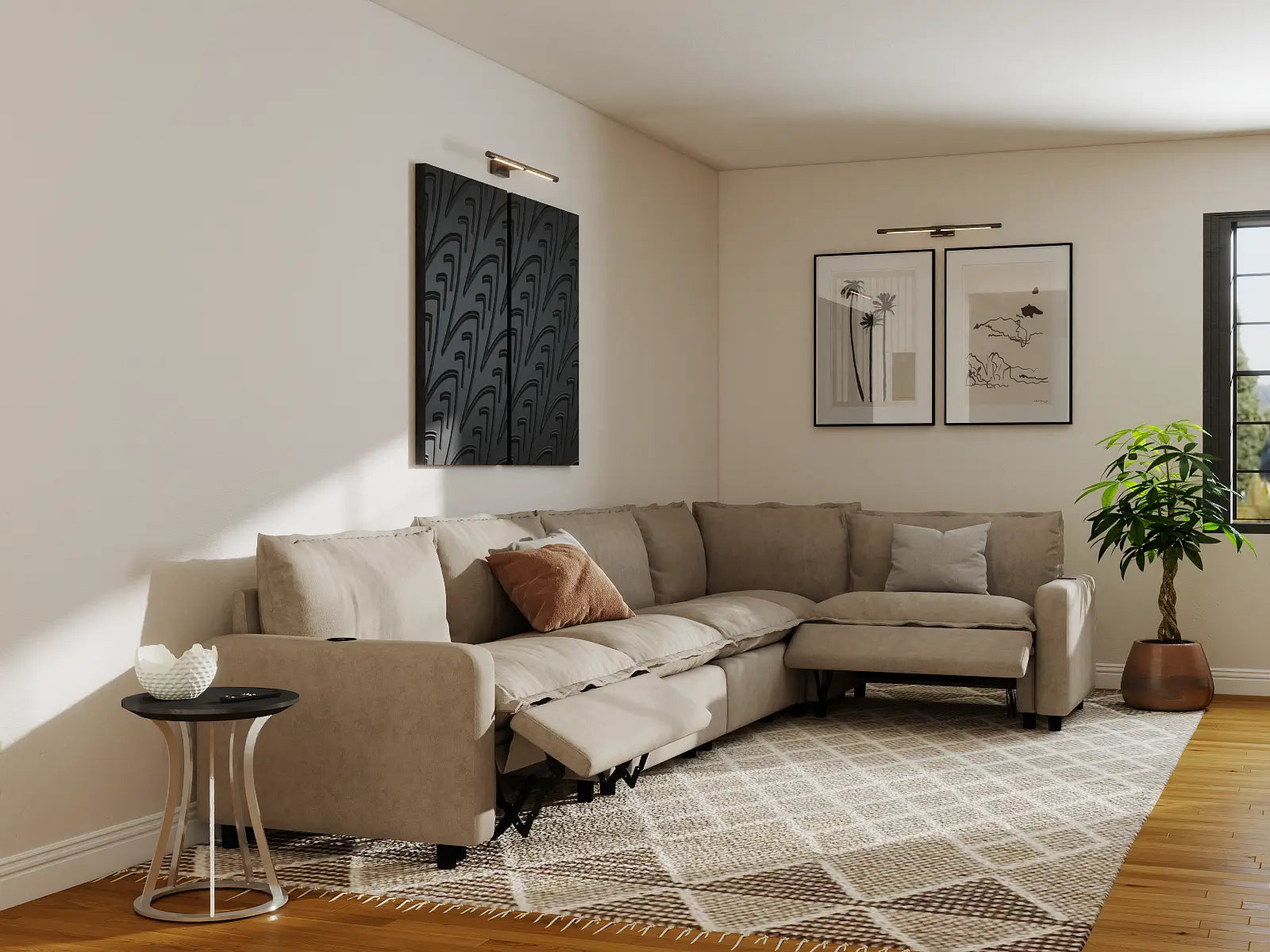
The key is choosing a small sectional with low arms and a clean profile, and positioning the chaise end into a corner so no floor space is wasted behind or beside it.
If you want to learn more, please see our How to Arrange L-Shaped Sofa in Living Room: A Simple Guide
Modular Sofa
Modular sofas are the most adaptable option for small or awkward spaces. You purchase only the modules you need - two seats, a corner unit, a small chaise - and configure them to fit your exact floor plan. As your space or needs change, you can add or remove modules. The downside is that modular systems tend to cost more per unit than conventional sofas.
If you want to learn about modular sofa, please see our Modular Sofa Reviews - Comfort, Flexibility & Value Explained
How Sofa Color and Fabric Affect the Perception of Space
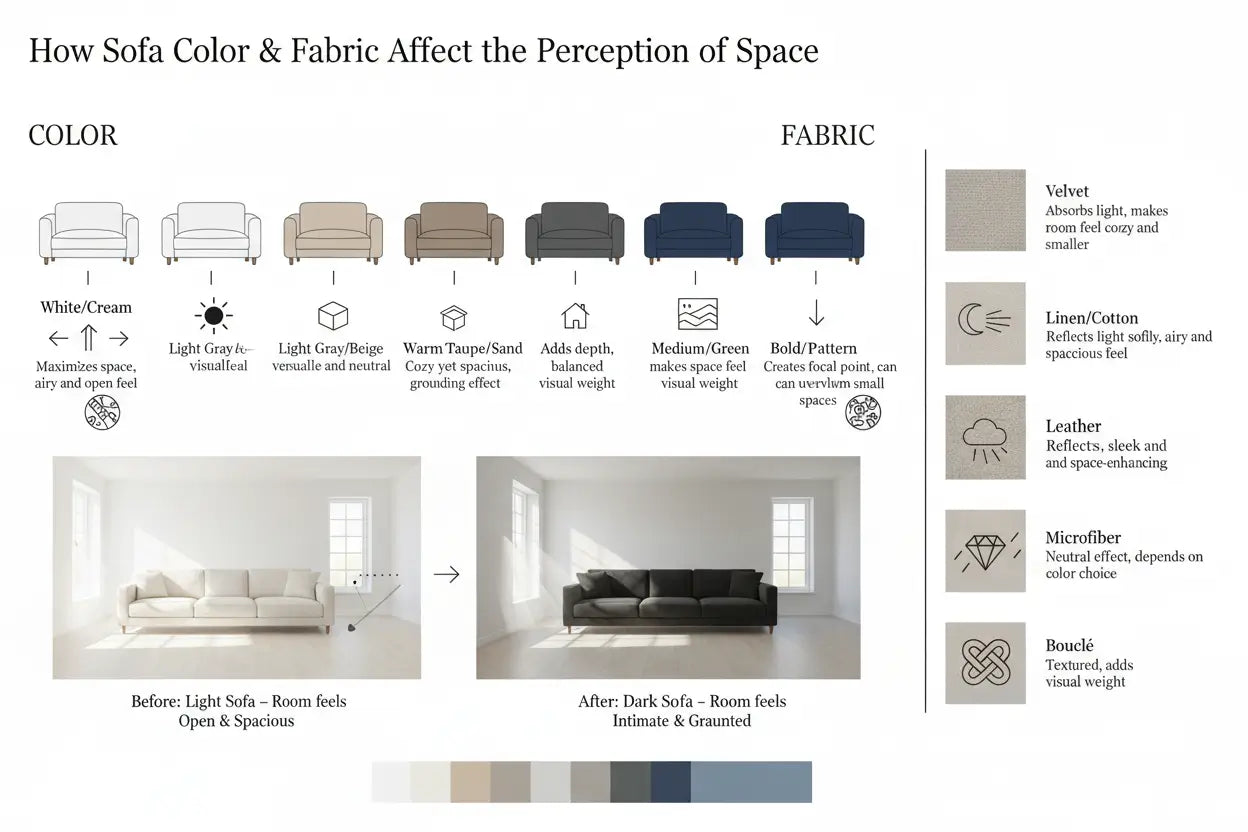
Color is one of the most powerful and most underestimated tools in small-space design. Your sofa's color does not just set a mood - it physically changes how large the room appears.
| Color | Visual Effect | Advantage | Watch Out For |
| White / Cream | Maximum space expansion | Visually merges with light walls | Shows stains easily - consider slipcovers |
| Light Gray / Beige | Neutral, airy feel | Versatile, hides light dirt | Most popular choice for small spaces |
| Soft Blue / Sage | Recedes visually, calming | Color without weight | Works best with white or light walls |
| Dark / Charcoal / Navy | Grounds the room, can feel heavy | Statement piece | Use only if room has good natural light |
| Bold Pattern | Can make room feel busy | Adds personality | Keep patterns small-scale; avoid large prints |
Light Colors Expand, Dark Colors Anchor
Light-colored sofas - white, cream, light gray, sand - visually recede and allow the eye to move around the room freely. When the sofa color is close to the wall color, the boundary between furniture and wall becomes less defined, making the room appear more continuous and spacious. This is one of the most effective and budget-friendly ways to expand a small room without any structural change.
Dark sofas are not automatically wrong in small spaces, but they require more natural light to avoid feeling oppressive. A charcoal sofa in a room with a large south-facing window can look sophisticated; the same sofa in a dim north-facing room will make the space feel like a cave.
Fabric Texture and Visual Weight
High-gloss or smooth fabrics (such as velvet, performance weave, or leather) reflect light and add a sense of luminosity, which can make the sofa feel lighter and the room feel brighter.
Matte, heavily textured fabrics (such as chunky boucle or heavily nubbed weaves) absorb light and add visual mass. Beautiful in large rooms, but potentially heavy in small ones. Use sparingly or in lighter colors.
Transparent-base materials such as metal legs combined with a light fabric create a sofa with minimal visual weight. The eye can partially see through and around the piece, which reduces its psychological footprint in the room.
Pattern Scale
If you want a patterned sofa in a small room, keep the pattern small-scale - small geometric prints, fine stripes, or subtle textures. Large-scale patterns draw attention to the size of the sofa and can make it feel like an even bigger presence in the room.
Sofa Placement Strategies That Make a Room Feel Larger
Even the perfect sofa can make a small room feel cramped if it is placed incorrectly. Placement is as important as the sofa itself.
Float the Sofa Away from the Wall
The most counterintuitive placement tip: do not push the sofa flat against the wall. It may seem like pulling the sofa even 20-30 cm away from the wall wastes space, but it actually creates a sense of depth that makes the room feel larger. When the sofa is plastered against the wall, the room can look flat and one-dimensional. A slight gap creates visual layering.
Create a Clear Traffic Path
Leave at least 60-90 cm of clear floor between the sofa and any opposite furniture, such as a coffee table or TV unit. This "traffic path" signals to the brain that the room has sufficient space to move through, which is a key part of how we perceive a room as large or small. If the sofa is so large that traffic paths are under 45 cm, it is too big for the space.
Corner Placement for L-Shapes and Sectionals
An L-shaped sofa or small sectional placed with the chaise tucked into a corner is one of the most space-efficient configurations in a small room. It consolidates all seating into a single corner zone, freeing up the opposite side and center of the room entirely. Avoid floating an L-shape in the middle of a small room, as this divides the already-limited floor area into non-functional strips.
Use the Sofa as a Room Divider in Open Plans
In open-plan studios or large single-room apartments, floating the sofa back-to-back with or perpendicular to a dining table defines distinct zones without adding walls. This is especially effective when the sofa has a finished or upholstered back, giving you a clean view from the dining zone.
Avoid Blocking Windows
Natural light is your most powerful tool in making a small room feel large. Never position a tall-back sofa in front of or beside a window in a way that blocks light. If wall space near a window is your only sofa placement option, choose a low-back sofa that sits below the window sill.
What to Avoid When Choosing a Sofa for a Small Living Room
⚠️ Common Mistakes to Avoid
These are the most frequent sofa-related design errors in small living rooms. Avoiding even two or three of them will produce a noticeably more spacious result.
- Oversized three-plus-seat sofasthat fill more than two-thirds of the primary wall. Even if they fit physically, they overwhelm the visual balance of the room.
- Sofas with very high backsthat sit above the bottom of your windows. High backs create a wall-within-a-wall effect that cuts the room in half visually.
- Heavily rolled or tuxedo armsthat add 15-20 cm of visual bulk on each side. Track arms or angled arms keep the silhouette lean.
- Dark, heavy fabrics in low-light rooms.A dark sofa in a room without abundant natural light is one of the fastest ways to make a space feel claustrophobic.
- Buying before measuring.Always measure the floor plan, the door and corridor dimensions the sofa must pass through, and the wall space before purchasing. A sofa stuck in a hallway because it does not fit through the door is one of the most expensive and frustrating furniture mistakes.
- Matching the sofa to existing oversized furniture.If the room already has a large TV unit, large bookcase, and large coffee table, adding a large sofa compounds the problem. In small spaces, at least two or three pieces of furniture should be scaled down.
Quick Sofa Size Guide for Small Rooms
Measurement Reference
Room under 12 m²: Max sofa width 160 cm. Loveseat or apartment 2-seater recommended. Room 12-18 m²: Max sofa width 180-200 cm. Apartment 3-seater or small L-shape works well. Room 18-25 m²: Max sofa width 200-240 cm. Small sectional or modular sofa is viable. Always maintain 60-90 cm traffic paths on all sides of the sofa.
Before you finalize any sofa purchase, use painter's tape on the floor to mark out the sofa's exact footprint. Live with the taped outline for a day. Walk around it, sit in the area, check the traffic flows. This single step prevents the most expensive small-space furniture mistakes.
Conclusion
Making a small living room feel bigger with the right sofa comes down to five interconnected decisions: size (proportionate to the room, not exceeding two-thirds of the wall), shape (low arms, high legs, compact profile), color (light tones that recede and reflect), fabric (smooth textures that reflect light), and placement (floated slightly from the wall with clear traffic paths on all sides). None of these decisions requires a large budget - the biggest gains come from better choices, not more expensive ones.
If you are looking for a sofa brand that has built its collection around exactly this challenge, Magic Home designs sofas with small and medium living rooms at the center of the brief - combining compact, space-conscious proportions with premium comfort engineering, so you never have to choose between a room that breathes and a sofa that feels good to sit in. From apartment-sized two-seaters to modular small sectionals with adjustable configurations, Magic Home offers the flexibility and quality that small-space living demands.
Frequently Asked Questions
Light colors - white, cream, light gray, or soft beige - are the best sofa colors for small living rooms. Light-colored sofas visually recede and blend with light-colored walls, making the room feel more open and continuous. If you prefer a darker sofa, ensure the room has good natural light and use it as a deliberate contrast against light walls.
if you want to learn more, please see our How to Choose the Perfect Sofa Color for Your Living Room
Measure the wall length the sofa will face and ensure the sofa is no more than two-thirds of that measurement. Then use painter's tape to mark the sofa's full footprint on the floor and check that at least 60 cm of clear walkway remains on all sides. Also measure doorways, hallways, and stairwells the sofa must pass through during delivery - sofas that do not fit through the entry are one of the most common and costly furniture mistakes.
If you want to learn more, please see our Sofa Size Guide: Dimensions, Measurements & Calculator