


Small Living Room Layout Ideas with a Reclining Sofa

A reclining sofa is one of the most comfortable pieces of furniture you can own - but fitting one into a small living room can feel like solving a puzzle. Between the footrest extension, the rear clearance, and keeping clear walking paths, the challenges are real.
The good news? With the right layout strategy, a reclining sofa can absolutely work in a small living room. You just need to know the rules before you start arranging furniture.
This guide covers everything: how much space a recliner actually needs, which types work best in tight rooms, the smartest furniture arrangements, and practical layout examples for apartments and compact living spaces.
Why Layout Planning Matters Before You Buy a Reclining Sofa
Most people buy the sofa first, then figure out placement. In a small living room, that approach leads to frustration - or worse, a sofa that can't fully recline without hitting a wall.
Before you shop, you need to know:
- The exact dimensions of your living room (length, width, and ceiling height)
- Where your doorways, windows, and electrical outlets are located
- How much clearance the reclining mechanism needs (front and rear)
- What size reclining sofa or loveseat will leave comfortable walking paths
Small Living Room Layout Ideas with a Reclining Sofa
Here are six proven layout configurations organized by room shape, size, and use case. Each layout includes specific dimensions, furniture recommendations, and notes on what makes it work in tight spaces.
Layout 1 - The Wall-Hugger Lineup (Best for Narrow Rooms)
This is the most reliable layout for rooms under 12 feet wide. Place a wall-hugger reclining loveseat or compact sofa directly against the longest wall. Mount the TV on the opposite wall and choose floating shelves or a narrow media console (under 14 inches deep) rather than a traditional TV stand.
Why it works: The wall-hugger mechanism means your sofa can sit close to the wall while still reclining fully. Positioning the TV directly opposite keeps sightlines clear without requiring additional furniture between the sofa and screen.
Layout specifics:
- Best room size: 10 x 12 ft to 11 x 14 ft
- Key furniture: Wall-hugger reclining loveseat (58-70 in wide), wall-mounted TV at 45-50 in height, two narrow side tables (max 18 in wide each)
- Walking path: Along the right and left sides of the sofa; primary path runs parallel to the sofa toward the room exit
- What to avoid: Placing a coffee table directly in front - it will block the footrest. Use a moveable ottoman pouf instead
Layout 2 - The Floating Island (Best for Square Rooms)
Pull the reclining sofa 16-18 inches away from the wall. This counterintuitive move actually solves several small-room problems at once: it gives the reclining mechanism room to operate, creates a defined seating zone, and allows a narrow console table to sit behind the sofa as a room divider.
A low-profile area rug (5 x 8 ft or 6 x 9 ft) placed under the sofa's front legs anchors the floating arrangement and visually defines the living zone in the room.
Layout specifics:
- Best room size: 12 x 12 ft or 13 x 13 ft
- Key furniture: Standard reclining sofa (up to 84 in wide), area rug, small round coffee table (24-30 in diameter) or a moveable ottoman tray
- Walking path: Around all four sides of the sofa grouping; the gap behind the sofa creates a natural second path through the room
- Bonus feature: The narrow console table behind the sofa can hold a lamp, books, or decorative items, functioning as a mini sideboard
Layout 3 - The Corner Configuration (Best for L-Shaped or Open Plans)
Position the reclining sofa along the longer of two adjacent walls, with a single accent chair or small reclining sectional anchoring the adjacent wall. This L-shaped seating arrangement uses the corner efficiently without overwhelming the room, and the open side of the L naturally creates the main traffic path.
A small sectional with one reclining end is particularly effective here: you get the comfort of a recliner plus the space efficiency of a sofa that fits flush into the corner rather than floating in the center.
Layout specifics:
- Best room size: 12 x 14 ft or larger
- Key furniture: Reclining sectional (with one or two reclining ends) OR a reclining sofa plus a compact accent chair
- Walking path: Through the open side of the L-shape; the corner becomes a contained seating zone with one main entrance/exit
- TV placement: On the wall facing the interior angle of the L, so both the sofa and the accent chair have a direct sightline
- What to avoid: Blocking the open side of the L with a large coffee table - use a side table or small C-table instead
Layout 4 - The Minimalist Studio Setup (Best for Apartments and Open Plans)
In an open-plan studio or one-bedroom apartment, the reclining sofa does double duty: it's the main seating AND the architectural divider that separates the living area from the dining or sleeping zone. Position the sofa with its back facing the dining or sleeping space, and mount the TV on the wall directly in front of it.
This layout eliminates the need for a TV stand, a console table, and often a coffee table - all high-footprint items. The back of the sofa becomes an informal boundary between zones without the visual weight of a wall.
Layout specifics:
- Best room size: Any studio or open-plan space; especially effective in studios under 500 sq ft
- Key furniture: Compact reclining loveseat (58-70 in wide), wall-mounted TV, floating shelves for media and storage
- Walking path: Around the perimeter of the sofa (primary), and behind it into other zones (secondary)
- Storage: Replace floor-standing storage with wall shelves at eye level or above to keep the floor completely clear
Layout 5 - The Recliner + Accent Chair Pairing
Instead of a full reclining sofa, this layout uses a single reclining sofa combined with one compact accent chair placed at a slight angle opposite or perpendicular. The accent chair creates conversational seating without the bulk of a second sofa, and its position can be adjusted as needed.
This layout works well when you need the room to feel social (for guests) but want the reclined comfort option for everyday use. A single shared side table or small ottoman between the two pieces keeps the arrangement connected.
Layout specifics:
- Best room size: 10 x 14 ft or 11 x 13 ft
- Key furniture: Compact reclining sofa (72-80 in wide), one armless or slim accent chair, a C-table or nesting side table between them
- Walking path: Between the sofa and chair creates a natural throughway; keep this gap at least 30-36 inches
- What to avoid: Choosing an oversized accent chair - it should be visually lighter than the sofa, not compete with it
Layout 6 - Side-by-Side Individual Recliners
Two individual recliner chairs placed side by side is one of the most flexible arrangements for small living rooms. Each chair can be angled slightly for better conversation, repositioned independently, or used solo without wasting the space a two-person sofa requires when only one person is seated.
This layout is especially effective in rooms that are longer than they are wide (like a 10 x 14 ft room), where a sofa would feel too wide but two chairs in a row feel proportional.
Layout specifics:
- Best room size: 10 x 14 ft or 11 x 12 ft
- Key furniture: Two compact recliner chairs (28-32 in wide each), one shared side table or small ottoman between them
- Walking path: In front of and behind the chairs; easier to reconfigure than a fixed sofa
- Flexibility advantage: Each chair can be angled 15-20 degrees inward to create a conversation-friendly V shape without adding any additional furniture
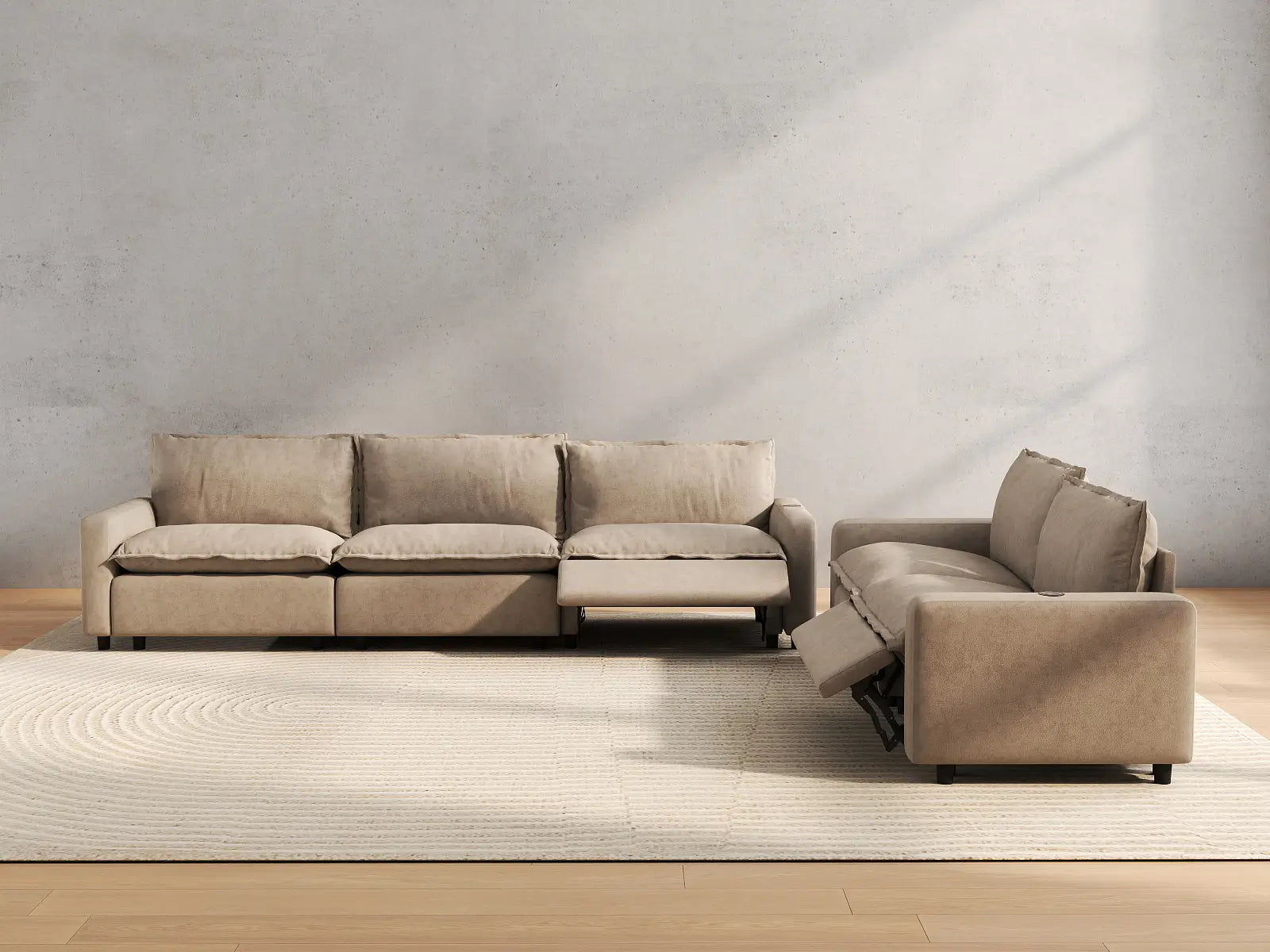
Space-Saving Tips for Small Living Rooms with a Reclining Sofa
Prioritize Wall-Hugger Models
If your room is under 12 feet deep, a wall-hugger recliner isn't just a preference - it's a necessity. The difference between needing 2 inches of rear clearance versus 18 inches is the difference between placing the sofa against the wall (where it belongs in a small room) and pulling it 18 inches into the room (wasting valuable floor space).
Wall-hugger models operate by sliding the seat forward as it reclines, which means the back of the sofa stays very close to the wall throughout the full reclining motion. Most major sofa manufacturers now offer wall-hugger versions of their compact reclining lines.
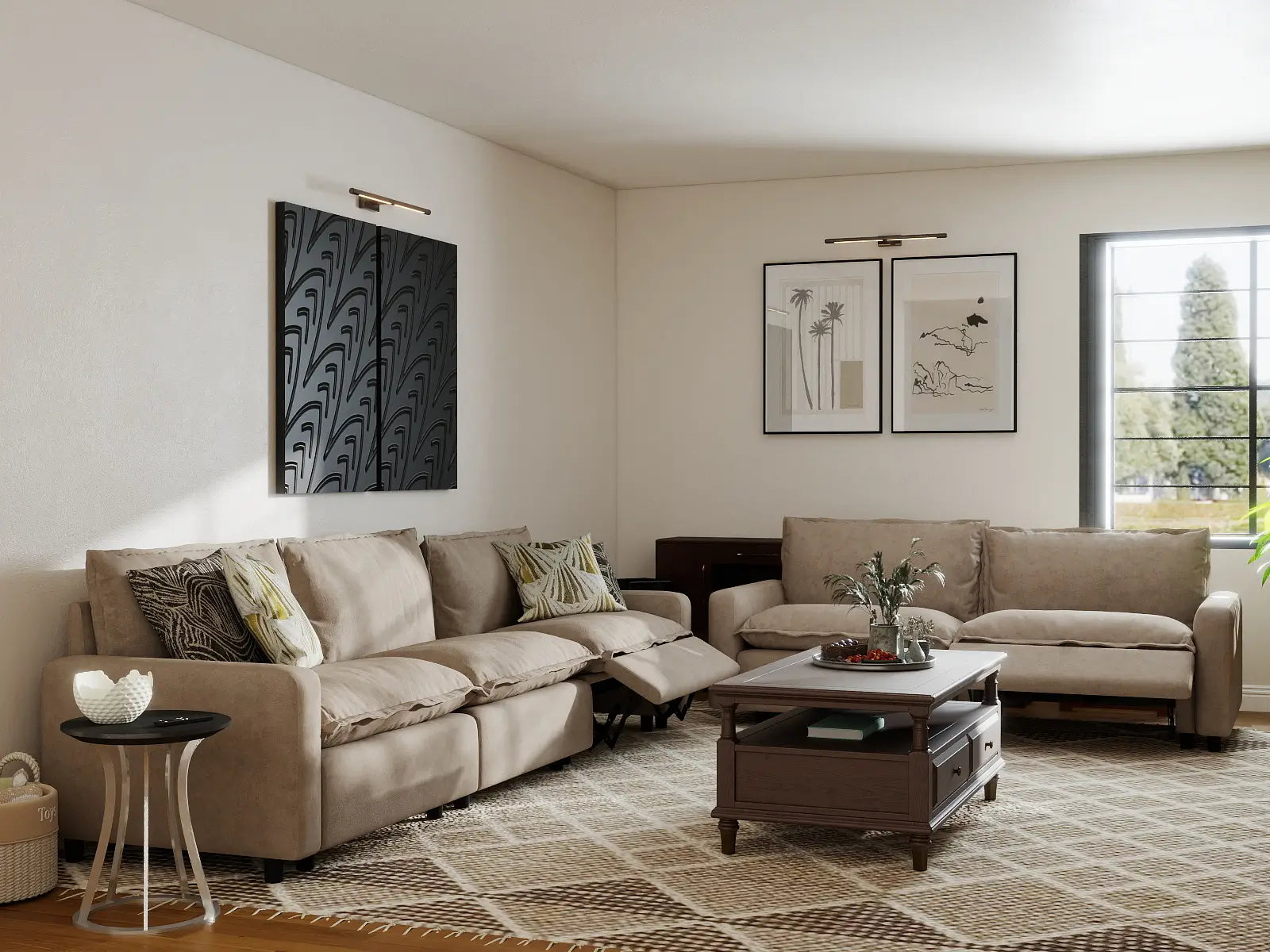
Replace the Coffee Table with an Ottoman
A traditional rectangular coffee table in front of a reclining sofa is a recipe for blocked footrests and frustrated movement. Swap it out for a soft ottoman or pouf that can be pushed aside when the footrest extends, then moved back into service as a tray surface when the sofa is in the upright position.
Look for ottomans with removable tray tops - they function as a coffee table surface when you need one and as a footrest or extra seating when you don't. Models with hidden internal storage add another layer of small-room utility.
Choose Low-Profile, Legless, or Slim-Arm Designs
Three design choices that make a big visual difference in small rooms:
- Low profile (under 34 inches tall): keeps sightlines open and makes rooms with lower ceilings feel taller
- Exposed or tapered legs: allow light to pass under the sofa, making the floor feel more open
- Slim arms (under 6 inches wide): modern recliners with tight, low arms take up significantly less width than traditional pillow-arm styles - some models save as much as 8-10 inches in total width
Use Vertical Storage Throughout the Room
Every inch of floor space you free up increases the functional area around your reclining sofa. Shift storage upward: tall bookcases, wall-mounted media consoles, floating shelves, and wall-hung cabinets keep the floor clear and make the room feel larger, even with a substantial reclining sofa in it.
Limit the Total Number of Furniture Pieces
One of the fastest ways to ruin a small-room layout is over-furniture-ing it. If the room has a reclining sofa, it does not need a matching loveseat, a sectional add-on, two accent chairs, a large coffee table, and a console table. Pick one accent piece - either a single chair or a small storage ottoman - and resist the urge to fill remaining floor space with additional seating.
Choosing the Right Size Reclining Sofa for a Small Room
Sofa sizing is the foundation of any successful small living room layout. Here's a quick reference guide.
| Sofa Type | Typical Width | Seats | Min. Room Width |
| Reclining Loveseat | 58-70 inches | 2 | 10 ft |
| Compact Reclining Sofa | 72-80 inches | 2-3 | 11 ft |
| Standard Reclining Sofa | 84-90 inches | 3 | 12 ft |
| Large Reclining Sofa | 92-100 inches | 3-4 | 13+ ft |
Note: 'Min. Room Width' refers to the minimum recommended room width to accommodate the sofa with comfortable walking clearance on both sides. Deeper rooms give you more flexibility with front clearance and reclining depth.
Quick Checklist: Is Your Small Living Room Ready for a Reclining Sofa?
Before finalizing your layout, run through this checklist:
- I've measured my room and mapped all doorways, windows, and outlets
- I know whether I need a wall-hugger or standard recliner based on available rear clearance
- My chosen sofa fits within the wall space with at least 3 inches of side clearance per side
- There is at least 24 inches of clear floor in front of the sofa when fully reclined
- My primary walking path is at least 36 inches wide
- No furniture or coffee table will block the footrest when extended
- I've considered a reclining loveseat if the room is under 11 ft wide
- I've accounted for door swing clearance in the layout
Final Thoughts
A reclining sofa in a small living room is absolutely achievable - it just requires thoughtful planning. The biggest mistakes people make are skipping the clearance math, choosing a sofa that's too wide, or placing it in a spot that blocks natural movement through the space.
Start with your room dimensions. Then choose between a wall-hugger and a standard recliner based on how much rear clearance you have. Consider a reclining loveseat if the room is under 12 feet wide. And always leave at least 36 inches for your main walking path.
With the right layout, your magic home reclining sofa won't just fit - it'll become the most comfortable and functional piece in your home.