


Complete Guide to Different Types of Reclining Sofas

Introduction
A reclining sofa is one of the most impactful pieces of furniture you can add to a living room. Yet when you start shopping, the options multiply fast - manual or power, wall hugger or full-travel, rocker, swivel, zero gravity, lift chair, sectional. Each type solves a different problem and suits a different household.
Understanding the differences before you buy means you will not end up with a sofa that takes up too much space, lacks the features you need, or fails to deliver the comfort level you expected. This guide covers every major reclining sofa type, how its mechanism works, who it is best suited for, and what to look for when comparing options.
A reclining sofa is one of the most impactful upgrades you can make to a living room - but the wrong type can leave you with a piece that does not fit your space, your posture needs, or how you actually use the room. Walk into any furniture showroom and the options multiply quickly: manual recliners, power models, wall huggers, zero gravity designs, lift chairs, rocker sofas, swivel models, and full reclining sectionals. Each solves a different problem.
This guide explains every major reclining sofa type - how each mechanism works, what space it requires, who it suits best, and what trade-offs come with it. By the end, you will have a clear picture of which type fits your home.
1. Manual Reclining Sofas
Manual reclining sofas operate entirely through mechanical means - no electricity, no motor, no components that require power. They are the original recliner design and remain one of the most dependable, widely available options on the market.
How They Work
The most common manual design uses a side-mounted lever or handle. Pulling it releases a spring-loaded latch that raises the footrest and tilts the backrest simultaneously. A second common design - the push-back recliner - reclines by applying body weight directly to the backrest with no visible handle, giving a cleaner silhouette that suits contemporary interiors.
Strengths
- No power outlet required - position them anywhere in the room
- Lowest purchase price among all recliner types
- Minimal components means fewer points of failure over the sofa lifespan
- Instant response with no motor lag
Limitations
- Stops at fixed preset angles rather than offering infinite adjustment
- Requires physical effort to operate - challenging for users with limited grip strength
- No integrated charging ports, heating, or adjustable headrests
For a direct side-by-side evaluation on cost, features, and long-term value, see the power vs manual recliners guide and the manual vs electric recliners comparison.
Quick Tip: Manual recliners are ideal for any room without a convenient wall outlet, and for buyers who prioritize reliability and simplicity over features.
2. Power Reclining Sofas
Power recliners - also called electric recliners - replace the mechanical lever with a control button on the armrest. A quiet electric motor drives all movement, giving you smooth, continuous adjustment across the full reclining range.
How They Work
Pressing the control button activates the motor, which drives the footrest and backrest to your desired position. Because the motor can stop anywhere in its travel range, power recliners offer infinite positioning - you choose the exact angle rather than accepting a preset stop. Many models have separate controls for the footrest, headrest, and lumbar support, allowing each section to be adjusted independently.
Common Integrated Features
- USB and USB-C charging ports built into the armrest or center console
- Powered adjustable headrests for individual neck support
- Seat heating and lumbar massage functions
- LED ambient lighting beneath or behind the sofa frame
- Memory save buttons that recall your preferred positions
- Rechargeable battery packs on some models, removing the need for a fixed outlet
Strengths
- Infinite positioning - find the exact angle your body needs
- Effortless to operate - accessible for elderly users or those with joint pain
- Integrates smart technology cleanly into the living room
Limitations
- Higher purchase price than a manual equivalent
- Motor components may require servicing over the sofa lifespan
- Requires power access - either a nearby outlet or a battery pack
Quick Tip: Power recliners are the right choice when precise comfort and smart features matter more than simplicity - especially for home theater setups or users with mobility considerations.
3. Wall Hugger Reclining Sofas
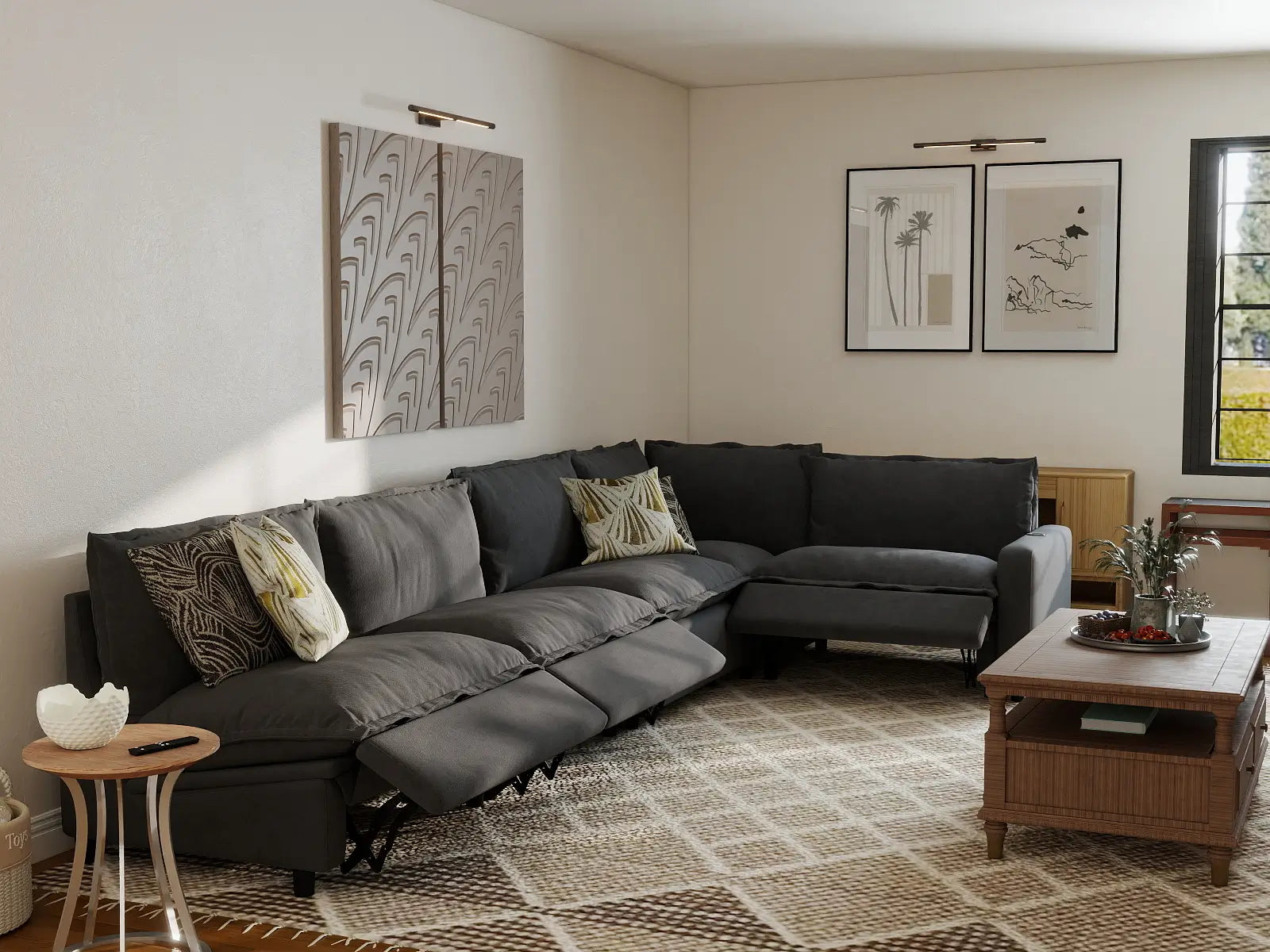
Traditional recliners push the backrest directly backward when reclining, requiring 12 to 18 inches of clearance from the wall. For smaller living rooms and apartments, that clearance is often unavailable. Wall hugger sofas solve this with a redesigned mechanism.
How the Mechanism Works
Instead of moving the backrest backward, a wall hugger recliner slides the entire seat forward on a track while the backrest reclines. Because the seat travels toward you before the back tilts, the rear of the sofa never swings out behind the frame. Most wall hugger models need only 4 to 6 inches of rear clearance.
What This Unlocks
- Sofas can sit flush against the wall without sacrificing reclining function
- Saves significant usable floor space in narrow or compact rooms
- Available in both manual and power configurations
Trade-offs
The wall hugger track adds slight cost and mechanical complexity over a standard recliner at the same size. The forward-slide motion also feels different from a conventional recliner - testing in person before purchasing is worthwhile if the sensation matters to you.
Quick Tip: If your sofa position leaves less than 12 inches from the wall, restrict your search entirely to wall hugger models. A standard recliner in that space will not fully extend.
4. Dual Reclining Sofas
A dual reclining sofa provides two independently controlled reclining seats - typically at each end - with a fixed center seat or storage console between them. Each occupant reclines at their own preferred angle without affecting the other.
Configuration and Sizing
Most dual recliners measure 72 to 90 inches wide, accommodating three people with reclining available for two. The center section commonly features a drop-down console with cup holders, USB ports, and small storage. Some models omit the center seat entirely in favor of a wider, more functional console.
Strengths
- Both users have fully independent reclining control
- More compact footprint than a full sectional
- Center console adds practical utility without visual bulk
Limitations
- The center occupant typically cannot recline
- Less seating flexibility than a sectional for households of three or more
Quick Tip: Dual recliners are the sweet spot for couples or two-person households who want independent comfort without the footprint of a full sectional.
5. Zero Gravity Reclining Sofas
Zero gravity recliners position the body in a posture modeled on NASA research into how astronauts float during launch - a position the body finds deeply decompressing. The knees are elevated slightly above the heart, the spine curves naturally, and body weight distributes evenly across the full back surface rather than concentrating in the lumbar region.
Physical Benefits
- Reduces compression on lumbar discs and spinal nerves
- Improves circulation by relieving pressure on the veins in the legs
- Decreases ankle and foot swelling after prolonged standing
- Supports deeper breathing by removing downward pressure on the diaphragm
- Often recommended for recovery from back surgery or management of chronic back pain
What to Expect
At full zero gravity position, the sensation is distinctly different from a standard reclined angle - most users describe a noticeable reduction in pressure through the back and thighs, sometimes described as floating. The typical posture reaches approximately 128 degrees at the hip-to-torso angle with the knees gently bent.
How It Fits Into Other Categories
Zero gravity positioning is a feature that overlaps with other sofa types - available in dedicated chairs, in power recliners with a zero-G preset, and in some sectional configurations. Look for it as a feature specification when shopping rather than a standalone product category.
If you are deciding between a standard recliner and a zero gravity model, the recliner vs zero gravity recliner comparison explains the ergonomic and practical differences clearly.
Quick Tip: Zero gravity positioning is most valuable for anyone with chronic lower back pain, circulation issues, or who spends extended time in the sofa for movies, reading, or recovery.
6. Reclining Sectional Sofas
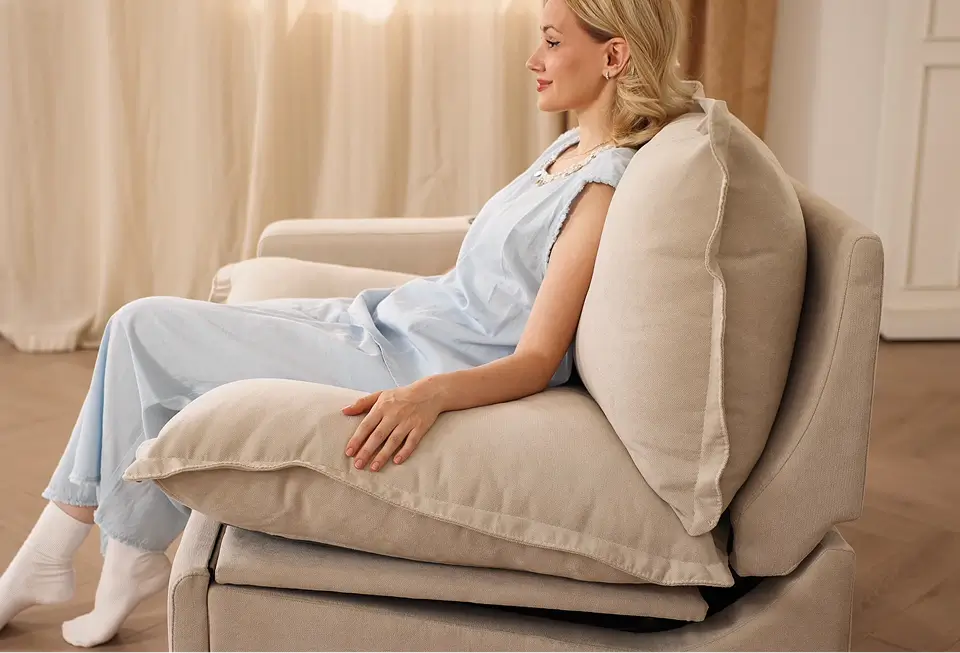
Reclining sectional sofas combine the generous seating capacity of a sectional layout with built-in reclining seats at multiple positions. They are among the most popular choices for family homes, media rooms, and open-plan living areas where multiple people need to relax simultaneously.
Common Layout Options
- L-shaped configurations with reclining end seats on one or both sides
- U-shaped layouts that wrap around a dedicated media space
- Modular sectionals with rearrangeable components that adapt to room changes
- Sectionals with a fixed chaise lounge for a single extended stretch
Features Commonly Included
- Drop-down center consoles with cup holders, USB charging, and concealed storage
- LED lighting strips integrated into the base or back panel
- Power headrests on each reclining seat
- Wall hugger mechanics on reclining positions to reduce required rear clearance
Space Considerations
Reclining sectionals are large by nature. Measure the full extended footprint before purchasing - particularly how far each footrest extends when fully open. Many buyers underestimate this by 12 to 18 inches per reclining seat. If the room cannot accommodate full extension, look specifically for sectionals that use wall hugger mechanics on the reclining seats.
Quick Tip: Sketch your room to scale before buying a reclining sectional. A sofa that looks right folded will often need significantly more floor space once all footrests are extended.
7. Rocker Reclining Sofas
Rocker recliners add a rocking motion to standard reclining function. A curved base allows the entire seat to rock gently forward and back while upright. Engaging the recliner lever then extends the footrest and backrest normally, with the rocking motion typically locking for stability in the reclined position.
Who Benefits
- Parents who find rocking motion useful when soothing infants or young children
- Anyone who finds gentle rhythmic movement relaxing during long viewing sessions
- Households transitioning from a porch or nursery rocker into a living room sofa format
Space Note
Rocker recliners need clearance at the front for the rocking arc in addition to rear clearance for reclining. Allow at least 8 to 10 inches of front swing room and do not place them flush against a wall at the front.
8. Swivel Reclining Sofas
Swivel recliners combine 360-degree rotation with full reclining function. More commonly available as individual chairs than full sofas, swivel reclining loveseats and compact two-seat sofas are widely available and growing in popularity for open-plan spaces.
Strengths
- Rotate to face any direction without moving the furniture
- Ideal for rooms that function as both lounging and conversation spaces
- Makes it easy to engage with different areas of an open-plan layout from one seat
Placement Requirements
Swivel mechanisms require a clear circular zone below the seat for the base to rotate freely. They do not work against walls or in tight corners. Position swivel recliners in the center of a room or anywhere 360 degrees of rotation is genuinely usable.
9. Lift Chair Recliners
Lift chair recliners are power recliners with an additional motor that tilts the entire seat forward and upward, bringing the user to a near-standing position. This dramatically reduces the effort required to stand - particularly important for users with limited lower body strength or joint pain.
How the Lift Works
Using a handheld control, the user activates the lift motor. The seat base tilts forward gradually until the person's center of gravity shifts enough to step out and stand without straining the knees, hips, or lower back. The reclining function operates independently from the lift.
Available Configurations
- Two-position: Upright and one reclined angle
- Three-position: Adds a near-flat or deep TV-watching position
- Infinite-position: Full power reclining with zero gravity preset options
Who Needs a Lift Chair
- Elderly users who struggle to rise from low seating
- Post-surgery recovery - particularly hip or knee replacement
- Users with arthritis, Parkinson's disease, or other mobility-affecting conditions
- Multi-generational households that want one accessible seating option
Quick Tip: Lift chairs are one of the most functional investments in an aging-in-place home and are frequently recommended by occupational therapists.
All Reclining Sofa Types at a Glance
| Type | How It Reclines | Power? | Price | Best Room | Best For |
| Manual | Lever / Push back | No | Low | Any room | Budget homes, simplicity |
| Power / Electric | Electric motor + button | Yes | Med-High | Modern living rooms | Tech lovers, mobility needs |
| Wall Hugger | Seat slides forward | Optional | Medium | Small rooms / apts | Space-saving priority |
| Dual Reclining | Two independent seats | Varies | Medium | Medium rooms | Couples |
| Zero Gravity | Elevated leg posture | Usually | Med-High | Any room | Back pain, long sessions |
| Reclining Sectional | Multiple reclining seats | Varies | Med-High | Large / open plan | Families, entertaining |
| Rocker Recliner | Rock + recline | No | Low-Med | Any room | Soothing motion lovers |
| Swivel Recliner | 360deg rotation + recline | Optional | Medium | Open plan rooms | Versatile positioning |
| Lift Chair Recliner | Power lift to standing | Yes | Med-High | Any room | Elderly, post-surgery |
How to Choose the Right Reclining Sofa
With nine types to consider, the right choice depends on working through five practical questions before committing to a style or mechanism.
1. How Much Rear Clearance Do You Have?
Measure from your planned sofa position to the nearest wall. At 12 inches or more, most standard recliners will work. Below 12 inches, restrict your search to wall hugger models only - a recliner that cannot fully extend provides no reclining benefit.
2. Manual or Power?
Manual is simpler, more affordable, and works anywhere without power. Power delivers infinite positioning, smart features, and effortless operation. If anyone in the household has limited hand strength or joint pain, a power model is worth the additional cost.
3. How Many People Need to Recline Simultaneously?
One or two people: a dual reclining sofa covers both independently. Three or more at once: only a reclining sectional can accommodate everyone. Single-person use: any end seat or dedicated recliner chair works.
4. Are There Specific Comfort or Health Needs?
Chronic lower back pain or circulation issues: zero gravity positioning offers genuine ergonomic value. Difficulty standing from seated: a lift chair recliner is the appropriate choice. Preference for gentle rocking motion: a rocker recliner suits this well. These differences are worth paying for when they apply.
5. What Upholstery Suits Your Household?
Homes with pets and children benefit from performance fabric or genuine leather - both wipe clean. Softer fabrics like velvet and chenille offer more warmth for extended lounging but require more careful maintenance. Leather develops character over years of use and resists odors well.
For a full breakdown of how leather and fabric compare on durability, cleaning, and cost, the leather vs fabric recliners guide covers all key factors in detail.
Recliner vs Lounger: Understanding the Difference
The terms recliner and lounger sometimes appear interchangeably in product listings, but they describe functionally different furniture. A recliner uses an active mechanism - mechanical or motorized - to change position on demand and returns to an upright seated position when not in use. A lounger such as a chaise longue has a fixed elongated shape with no moving parts - always the same configuration.
Both provide a reclined resting posture, but a recliner is a dual-function piece while a lounger is a dedicated resting surface. The right choice depends on whether you need a sofa that also works for upright sitting, or a separate piece purely for lying down.
The recliner vs lounger comparison guide walks through which format works better for different room sizes, layouts, and lifestyles.
Conclusion
The right reclining sofa depends on far more than style preference. Room dimensions, household size, mobility needs, and how you actually spend time in your living room all determine which mechanism and configuration will serve you well long term.
Magic Home designs reclining sofas across all major categories - manual, power, wall hugger, dual, sectional, and more - with an emphasis on quality upholstery, durable mechanisms, and designs built to stay comfortable for years. Browse the Magic Home reclining sofa collection to find the model that fits your space and your life.