


Wall Hugger vs Standard Recliner: Which Saves More Space?

Introduction
Choosing the right recliner can make a big difference, especially if your living room has limited space. Many homeowners compare Wall Hugger Recliner designs with a Standard Recliner when trying to keep their layout open and comfortable. While both options offer relaxing seating, they use different reclining mechanisms that affect how much room they need behind the chair. Understanding these differences helps you plan a smarter furniture layout and avoid wasting valuable floor space. In this guide, you will learn how each recliner works, how much clearance it needs, and which option saves more space in small living rooms or apartments.
Wall Hugger vs Standard Recliner: How They Work Differently
Understanding why one saves more space than the other starts with the mechanism inside each chair.
How a Standard Recliner Works
A standard recliner reclines by pushing the back of the chair backward. When you lean back and pull the lever, the entire backrest tilts away from its upright position - moving toward the wall behind it. This backward motion is what demands clearance space. The further back the chair reclines, the more space it needs.
Most standard recliners need 12 to 18 inches of empty space between the back of the chair and the wall. Push the chair too close, and it simply won't open fully - or worse, it will scuff or dent your wall.
How a Wall Hugger Recliner Mechanism Works
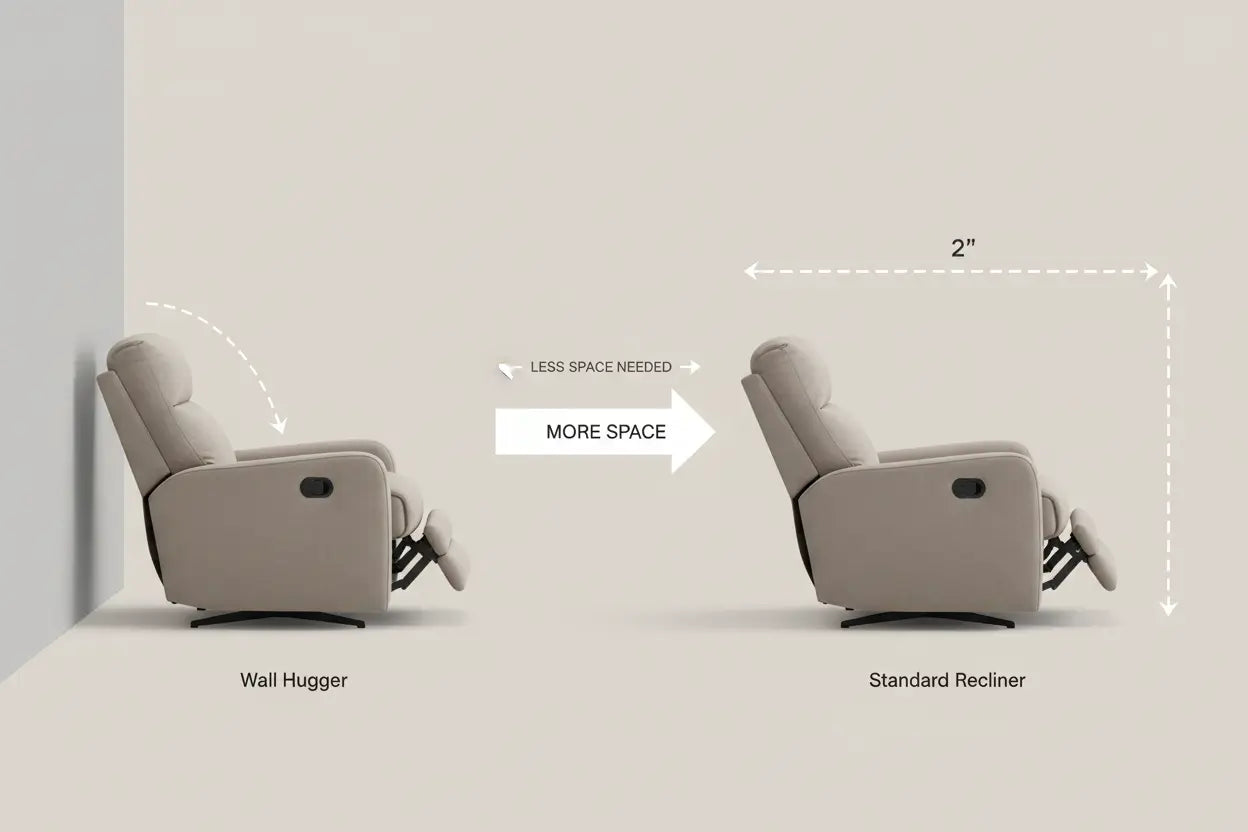
A wall hugger recliner - sometimes called a proximity recliner - works on an entirely different principle. Instead of pushing the backrest backward, the mechanism slides the entire seat forward as the backrest reclines. The chair moves toward you, away from the wall, rather than away from you, toward the wall.
This forward-glide motion is the key innovation. Because the chair is moving in the opposite direction, the backrest never gets closer to the wall during the reclining process. In fact, the back of the chair stays roughly in the same position - or barely moves at all.
The result: a wall hugger recliner can sit just 3 to 6 inches from the wall and still recline completely.
if you want to learn more, please check here:What Is a Wall Hugger Recliner? Your Guide to Easy Comfort
Real Space Measurements: Wall Hugger vs Standard Recliner
Here's a side-by-side comparison of the clearance each type typically requires:
| Feature | Standard Recliner | Wall Hugger Recliner |
| Distance from wall (upright) | 6-12 inches | 3-6 inches |
| Additional clearance needed to recline | 12-18 inches | 0-3 inches |
| Total wall clearance needed | 18-30 inches | 3-6 inches |
| Footrest extension (depth) | 18-24 inches forward | 18-24 inches forward |
| Best for small rooms? | No | Yes |
| Average Price Range | $300-$800 | $400-$1,000 |
| Average Weight | 80-120 lbs (36-54 kg) | 90-130 lbs (41-59 kg) |
Which Is Better for Small Rooms? Wall Hugger vs Standard Recliner
The Problem with Standard Recliners in Small Spaces
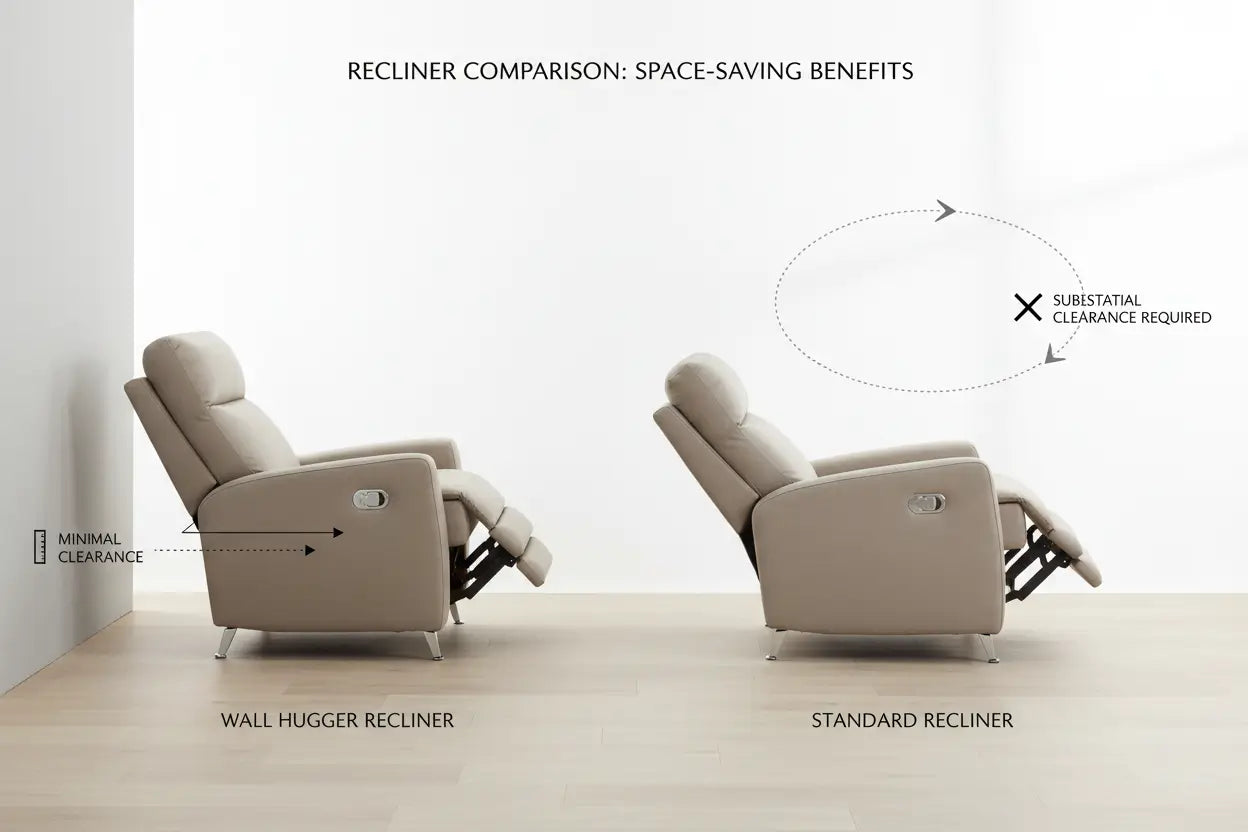
In a small living room or apartment, furniture placement is a puzzle. Every inch matters. Standard recliners force you to pull the chair well away from the wall to leave the required clearance - and that gap of dead space behind the chair adds up fast.
In a 10 x 12 foot living room, for example, a standard recliner placed with proper clearance can eat up nearly a third of the room's usable depth before you've even accounted for a coffee table or TV stand.
Why Wall Hugger Recliners Are Designed for Compact Living
A wall hugger recliner is purpose-built for exactly this situation. You can tuck it close to a wall, against a built-in bookshelf, or in a corner alcove - and still enjoy a full recline. This makes it the go-to choice for:
- Studio and one-bedroom apartments with limited square footage
- Small living rooms where seating needs to stay close to walls
- Bonus rooms, home offices, and bedrooms where space is tight
- RVs and mobile homes where every inch is at a premium
When a Standard Recliner Is Still Worth Considering
Wall hugger recliners win on space, but standard recliners aren't without merit. There are situations where a standard recliner is still a reasonable or even better choice.
You Have a Large Room
If your living room is spacious - say, 15 x 18 feet or larger - the extra clearance a standard recliner requires is unlikely to feel like a sacrifice. The additional 12 to 18 inches behind the chair won't disrupt the layout or crowd the space.
You Prefer a Deeper Recline Angle
Some standard recliners offer a flatter, near-horizontal recline angle that certain wall hugger models don't match. If you want a position that's closer to lying flat - ideal for napping or watching TV at length - a standard recliner may offer more complete recline travel.
You're Placing It Away from Walls
If the recliner will float in the middle of the room, surrounded by open space on all sides (common in large open-plan layouts), the wall clearance advantage of a wall hugger becomes irrelevant. In this case, choose based on comfort, style, and price rather than mechanism type.
Budget Considerations
Standard recliners are often less expensive because their mechanism is simpler and has been manufactured at scale for decades. If budget is a primary factor and you have the space, a standard recliner may offer more features per dollar.
Quick Decision Guide: Wall Hugger vs Standard Recliner
✔ When Space is Tight
Choose Wall Hugger Recliner
- Requires very little clearance behind the chair
- Can sit close to walls or in corners
- Ideal for small apartments, bonus rooms, or narrow living spaces
Avoid Standard Recliner
- Needs significant clearance behind to fully recline
- Takes up more usable floor space
✔ When Comfort and Recline Depth Matter
Choose Standard Recliner
- Often provides a deeper recline angle
- May feel more relaxed for long naps or full recline positions
Consider Wall Hugger Recliner Too
- Many models still offer generous recline
- Better for frequent sitting without sacrificing space
✔ When Budget is a Priority
Choose Standard Recliner👉 Basic standard models usually cost less
👉 Simple mechanism means easier servicing and replacement parts
Wall Hugger Recliner👉 May cost more due to specialized mechanism
✔ When Mobility and Weight Are a Consideration
Standard Recliner✔ Generally lighter and easier to move
Wall Hugger Recliner⚖ Slightly heavier due to sliding mechanism
🧠 Bottom Line Summary
- Small rooms or limited wall clearance? → Wall Hugger Recliner
- Want deeper recline and a lower price point? → Standard Recliner
- Long-term sitting with back support in mind? → Look for medium-firm cushioning in either type
The Bottom Line: Which Saves More Space?
When comparing wall hugger vs standard recliner for space savings, the answer is clear: the wall hugger wins every time in compact settings. Its forward-sliding mechanism allows it to sit just 3 to 6 inches from the wall - compared to the 18 to 30 inches of total clearance a standard recliner demands. For small apartments, narrow living rooms, or any space where floor area is limited, a wall hugger recliner isn't just convenient - it's transformative.
That said, if you have the room to spare and want maximum recline depth, a standard recliner remains a solid choice. The key is matching the mechanism to your space, not simply choosing one type by default.
Conclusion
When space is limited, a wall hugger recliner is the clear winner over a standard recliner - requiring as little as 3 to 6 inches from the wall versus up to 30 inches of total clearance for a standard model. For anyone furnishing a small apartment or compact living room, that difference isn't just convenient - it can completely change how the room functions. If you're looking for recliners that balance comfort with smart space efficiency, Magic Home is a brand worth exploring. Known for their well-crafted, space-efficient recliner sofas, Magic Home offers designs that work beautifully in smaller living spaces without compromising on comfort or style.